Showing posts with label Camarines Sur. Show all posts

A Surprising Find in Naga City: Museo Historico de Universidad de Sta. Isabel

June 15, 2026
Inside the quiet campus of Universidad de Sta. Isabel in Naga City, the Museo Histórico de la Universidad de Sta. Isabel preserves a profound collection of saintly relics, colonial-era art, and artifacts highlighting faith, revolution, and the pioneer roots of women's education in Southeast Asia.
Naga City / Bicol / Historical Heritage

A Surprising Find in Naga City: Museo Historico de Universidad de Sta. Isabel

By Marky Ramone Go June 2026

For most, the image of a museum appears to be fronted by a huge façade beaming in all white with giant columns and inside, spacious halls with giant galleries. And then there are those that remain almost hidden in plain sight, tucked behind old corridors, historic walls and in the case of this surprising find in Naga City, inside the grounds of a trailblazing university.

The original spiral staircase and architectural structure inside the University campus
The spiral stair and the adjoining hall are from the original structure of the University

Inside the campus of Universidad de Sta. Isabel in Naga City, the Museo Histórico de la Universidad de Sta. Isabel functions exactly like that: hiding a rich collection of artifacts related to faith, revolution and women’s rights.

A detailed bust portrait monument of Bishop Francisco Gainza
A bust of Bishop Francisco Gainza

The museum does not simply narrate the history of a pioneering university. It also tells the story of a transforming country beginning in the latter decades of the 19th century.

The Beginning of Universidad de Sta. Isabel de Naga

Declared a National Historical Landmark, the university traces its origins to 1868, when Bishop Francisco Gainza, a Spanish Dominican bishop assigned to Nueva Cáceres, the old name of Naga, envisioned something radical for its time: a formal institution dedicated to the education of women. In an era when women were largely confined to domestic roles, the idea bordered on revolutionary.

Exhibited gallery paintings inside the museum tracking the foundations of the university
The gallery opens with a series of paintings depicting the University's origins
“Women have a big role in society,” museum curator Luis Banzuela explained during a guided tour through the galleries. “By educating women, you can educate the world.”
Archival centennial commemoration oil paintings hung on the museum display walls
These artworks were painted during the University's Centennial celebration in 1968

The bishop’s dream would eventually become the first normal school for women in Southeast Asia, and among the earliest institutions in Asia dedicated to training female teachers.

The reconstructed traditional uniform garment known as the Saya Negra Suelta
The Saya Negra Suelta

At first, there was no grand campus. The school temporarily occupied rooms inside the convent beside the cathedral. Gainza wanted permanence. In a petition to Spain, he requested that the school be built beside the cathedral, the bishop’s palace and the seminary. The location of the university today stands as the fulfillment of that request.

A curated display counter containing historical books and colonial artifacts inside the gallery
One of the galleries displays the artifacts, old photos of the University

The museum’s first gallery recreates this origin story through a series of paintings completed in 1968 for the institution’s centennial anniversary. They are among the museum’s most prized pieces: visual chronicles of arrival, aspiration and colonial-era Bicol.

Museum curator Luis Banzuela explaining exhibits to visitors
Museum curator Luis Banzuela

One canvas depicts the six Daughters of Charity sisters from Spain who stayed at the university for some time after Gainza secured royal approval for the school. According to Banzuela, locals were astonished by the sight of women clothed in garments resembling those of priests and the series of paintings shows how the locals welcomed them.

Unearthed historical archeological fragments and digs found on the school grounds
Other items on display includes artifacts found in a dig on the site of the school

One painting shows their difficult voyage into Bicol in April 1868, traveling through the Bicol River aboard local watercraft from Pasacao to Nueva Cáceres in time for Palm Sunday.

Group archival photo of travel writers alongside museum curator Luis Banzuela
Group photo with museum curator Luis Banzuela

Elsewhere in the gallery hangs a recreation of the school’s early uniform, the saya negra suelta, a school implemented dress worn by the students to discourage sharp distinctions between those coming from wealthy families and those from poorer communities.

Archival print display detailing one of the original Spanish sisters of the Daughters of Charity order
Photo of one of the six Daughters of Charity

“To discourage discrimination between the rich and poor,” Banzuela explained, “all girls wore black.”

That commitment to education extended beyond finishing-school refinement. After only a few years, Gainza grew dissatisfied that graduates were not becoming teachers. He petitioned Spain again, this time to elevate the institution into an Escuela Normal de Maestras, a teacher-training school. Approval arrived in 1872.

Museum curator Luis Banzuela showcasing century-old reference texts and volumes
Century old books

The word “normal,” Banzuela explained to visitors, did not refer to ordinary schooling but to norms or standards of teaching. In modern terms, it was teacher education.

Inside glass cases are photocopies of application letters written by young women hoping to study there, maps showing how students traveled from across Luzon to Naga, and speeches intended for the first graduates of the teacher-training program. One address, written by Gainza in Spanish for the school’s first eleven graduates, had to be delivered by someone else because the bishop had grown too ill to read it himself.

But perhaps the museum’s most remarkable collection lies deeper inside the galleries: its relics.

The Saintly Relics – the Museum’s Highlight Collection

Rows of shrines containing first, second and third-class relics of saints line the displays with surprising numbers. Some contain fragments of bone. Others preserve cloth touched by canonized figures. For Catholic visitors, they are sacred objects. For historians, they are artifacts of devotion and ecclesiastical networks stretching across continents.

A close-up view of the royal relic of Saint Elizabeth of Hungary gifted by the Queen of Spain
relic of St. Elizabeth

Among the most prized pieces is a reliquary gifted by Queen Isabella II to Bishop Gainza during an audience in Spain on October 1, 1867. The story behind it was made more fascinating by how Banzuela narrated it to us. Gainza had traveled to Europe and hoped to personally meet the queen after years of writing letters about his plans in Bicol. During their meeting, he discussed his vision of establishing a school for women in Nueva Caceres. Pleased with the bishop’s mission, the queen presented him with a relic associated with Elizabeth of Hungary, the saint for whom the school would later be named (Isabel is the Spanish version of the name Elizabeth).

The grand array of saintly artifacts inside the dedicated Relics of Saints Gallery
The Relics of Saints Gallery

For years, the object was introduced simply as a relic of St. Elizabeth. Later research, however, suggested that the relic also contained something far rarer: a fragment believed to be from the True Cross. Inside the small container rests a tiny piece of wood said to come from the cross upon which Jesus was crucified.

Relic of Pope Saint John XXIII
Relic of San Juan XXIII, Pope

According to Banzuela, Queen Isabella II herself was believed to be a descendant of St. Elizabeth of Hungary, adding another layer of symbolism to the gift. The queen, he said, chose to dedicate the school not after herself, but after a “celestial queen.”

Relic of Saint Martin de Porres
Relic of San Martin de Porres

The museum’s relic collection, accumulated from gifts from the Spanish Queen, as she grew more admiring of the university’s functions, also includes first-class relics connected to Vincent de Paul and Louise de Marillac, reinforcing the university’s deep ties to the Vincentian tradition.

Relic of Saint Vincent de Paul
Relic of St Vincent de Paul

Other than religion and education, the museum also displays the scars of war. During the Philippine Revolution, the campus served as headquarters for Filipino rebels, including Corporal Elias Angeles, who led revolutionary forces in Bicol against the Spanish in 1898. During World War II, the Japanese military occupied the campus as a garrison. American bombings reduced much of the original structures to ruins.

Relic of Saint Louise de Marillac
Relic of Sta Luisa de Marillac

Photographs displayed in the galleries show shattered walls and skeletal remains of buildings. Empty bomb shells, wartime currency known as “Mickey Mouse money,” and surviving artifacts from the occupation are displayed in one of the galleries.

Relic of Pope Saint Pius X
Relic of St Pio X, Papa

For all its historical significance, however, the museum remains low-key. Banzuela guides visitors like a storyteller eager to share overlooked details: the social hierarchy reflected in antique chicken carriers called gallineras; the vanished relics and wartime artifacts stolen before heritage preservation became a thing; the annual rotation of objects from storage to keep repeat visitors returning.

Relic of Saint Maria Goretti
Relic of Sta Maria Goretti

There is something more appealing about the place. In an age when museums increasingly compete for grandness, the Museo Histórico de la Universidad de Sta. Isabel instead relies on the stories it tells, especially about a city once called Nueva Caceres, of women breaking social boundaries through education, of revolutionaries and six nuns, of relics traveling from royal courts in Spain to a university in Bicol. Maybe that is what makes this museum a must-visit among history enthusiasts and why it remains one of the top favorites of this writer.

Relic of Saint Therese of Lisieux
Relic of Sta Teresita of Lisicux

This article first appeared on Rappler.

BidiBidi Enterprise and the “Buhimian” Weavers of Buhi | Camarines Sur

February 14, 2023
Discover the traditional 'hinabol' handloom weaving of Buhi, Camarines Sur, and the hand-embroidery renaissance led by Bernadette De Los Santos at BidiBidi Café in Baao, Bicol. A look into community-based sustainable tourism and empowering rural women.
Bicol / CamSur / Sustainable Craft

BidiBidi Enterprise and the “Buhimian” Weavers of Buhi | Camarines Sur

By Marky Ramone Go February 2023

I first heard of the creations of BidiBidi when I was given an embroidered face mask featuring a beautiful portrait of a woman on one side and a woven pattern on the other. If there's one good thing to come out of the pandemic, it’s the use of fashionable face masks, and the one created by BidiBidi tops all I've worn.

Traditional woman weaver in Buhi Camarines Sur
One of the women weavers in Buhi showing us a sample work of hers

Since then, I’ve heard nothing but praise about how this social enterprise empowers a network of more than 200 women in Bicol in harnessing their skills in weaving, embroidery and crocheting to improve their economic standing in their communities.


A TPB-organized Workshop

As luck would have it, I found myself half a year later in Buhi, Camarines Sur, the same place where BidiBidi Social Enterprise operates, to attend a workshop called “Marketing Enhancement on Sustainable Community-Based Tourism”. Conducted by the Tourism Promotions Board of the Philippines (TPB), it was attended by the members of BOKPA (Buhi One-town, One-Product Key Players Association).

Tourism Promotions Board workshop banner in Camarines Sur
Thanks to TPB for conducting this Sustainable Community-based Tourism workshop in Buhi, Camarines Sur

In addition to enhancing quality control, designing, and workflow procedures, the workshop introduced the One-Town, One-Product (OTOP) creators of Buhi to the know-hows to sell their creations in social media. Apple Allison, a brand builder and idea accelerator, led the workshop. With her background in marketing, communication, brand-building, creative education and coaching — among her many hats, she was able to teach the women weavers many of the modern best practices for promoting and improving the quality of their products.

Weavers of Buhi stylish handwoven footwear
The weavers of Buhi incorporates their woven creations into stylish shoes

Some of the weavers of Buhi, Camarines Sur, invited us to their homes after the first day of the workshop to show us their woven materials, which are in high demand among designers of clothing and footwear, as well as other finished products, which included table runners and bedsheets to laptop sleeves and pouches.

Buhinon traditional finished woven cloth panels
These finished woven cloth will look good in your homes

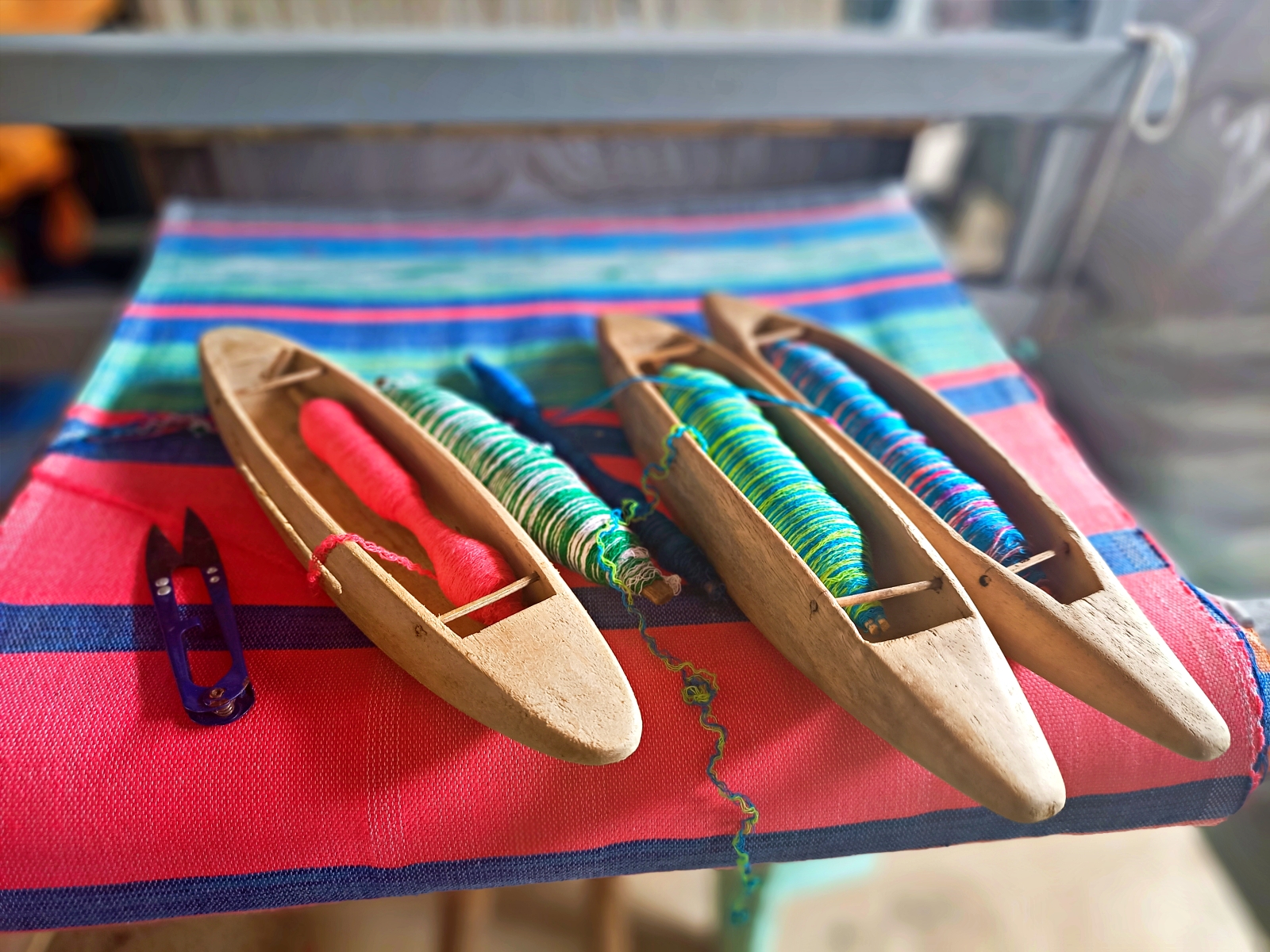
There was a time back in the 1960s when the town of Buhi became famous for its handloom weaving tradition, which the locals called "hinabol". Timeless Filipino clothing like the Baro't Saya, Kamisa de Chino, and the ubiquitous sleeping essential kumot, became the most sought-after creations.

Hinabol loom weaving tools in Buhi

As told to us by Clarita Noble of BOKPA, the practice of handloom weaving quickly faded out when ukay-ukay garments from abroad and shopping malls displaced local clothing producers.


Located not far from each other were the four houses we visited. Each has their own weaving pedal looms. One creates purely table runners and bedsheets, the other specializes on bags and shoes while the others make a variety of both.

Clarita Noble showing traditional wooden pedal loom
Clarita Noble of BOKPA shows us one of the weaving pedal looms they use

I also discovered that the more than 70 members of BOKPA and the creators of Buhinon Woven Products were not all women, as we met a male weaver whose voice cracks up with emotion as he told us about the economic benefits his family had gained from him learning to weave.


Brewing Art in BidiBidi Café

Bernadette De Los Santos, an artist, social entrepreneur, environmentalist and farmer based in Camarines Sur founded BidiBidi (based on Bernadette’s childhood nickname) in 2017, by teaching more than 150 women in her hometown of Baao, the skill of hand embroidery.

BidiBidi Cafe interior facade in Baao Bicol

Unbeknownst to most, Baao was formerly the hub of embroidery in the Bicol region. By taking charge of the renaissance of the craft, De Los Santos' BidiBidi brings the craft's resurgence full circle, producing a seamless transition from that intriguing period in Baao's history to the present.


"My target beneficiaries were the rural women, mostly wishes of farmers. Being a farmer myself, I know that they need extra income to augment the family budget" said Delos Santos.

Embroidered and crocheted bags at BidiBidi Cafe
Who won't get "budol-ed" into buying this beautiful BidiBidi items?

By sourcing most of her sustainable materials from Buhi, BidiBidi formed and developed a lasting collaborations with the women weavers whose creations De Los Santos aptly describes as “Buhimian”, a reference to the municipality of Buhi and a play on the word "bohemian," typically used to denote unconventional artistry.

BidiBidi embroidered face portrait tote bags
The unique artwork and designs of BidiBidi bags instantly pops out

Located on the ground floor of De Los Santos’ ancestral house in Baao, BidiBidi Café not only brews coffee and tea but embroidered, woven, and crocheted works of art as well.

Eclectic artistic installations inside BidiBidi Cafe
We had cold brew and Bicol Express Pasta here

The showcased BidiBidi merchandise, featuring De Los Santos' signature hand-embroidered faces, hangs on the walls, and the eclectic mix of artworks, art installations, colorful yarns and textiles, and repurposed furniture gives the space an artistic vibe. It came as no surprise for our group to be willfully “budol-ed” into buying numerous items from large to medium-sized bags, laptop sleeves to smaller items.

Artistic colorful yarn displays BidiBidi
Inside BidiBidi Cafe, there's artworks found everything everywhere all at once.

The future looks promising for the communities in this region of Camarines Sur to market their long-standing traditional weaving practice as a major One-Town, One-Product produce through Sustainable Community-Based Tourism, thanks in large part to the workshop conducted by TPB and the already flourishing collaboration between BidiBidi and the Buhi-mian weavers of Buhi.

Media group holding items with founder Bernadette De Los Santos
Groufie while holding our purchased items with BidiBidi founder Bernadette De Los Santos
More Travel Stories