
I first heard of the creations of BidiBidi when I was given an embroidered face mask featuring a beautiful portrait of a woman on one side and a woven pattern on the other. If there's one good thing to come out of the pandemic, it’s the use of fashionable face masks, and the one created by BidiBidi tops all I've worn.
BidiBidi Enterprise and the “Buhimian” Weavers of Buhi | Camarines Sur
Since then, I’ve heard nothing but praise about how this social enterprise empowers a network of more than two hundred women in Bicol in harnessing their skills in weaving, embroidery, and crocheting to improve their economic standing in their communities.

A TPB-organized Workshop
As luck would have it, I found myself half a year later in Buhi, Camarines Sur—the same place where BidiBidi Social Enterprise operates—to attend a workshop called “Marketing Enhancement on Sustainable Community-Based Tourism.” Conducted by the Tourism Promotions Board of the Philippines (TPB), it was attended by members of BOKPA (Buhi One-Town, One-Product Key Players Association).

In addition to enhancing quality control, design, and workflow procedures, the workshop introduced the One-Town, One-Product (OTOP) creators of Buhi to the know-how required to sell their creations on social media. Apple Allison, a brand builder and idea accelerator, led the workshop. With her background in marketing, communication, brand building, creative education, and coaching—among her many hats—she was able to teach the women weavers many of the modern best practices for promoting and improving the quality of their products.

Some of the weavers of Buhi, Camarines Sur, invited us to their homes after the first day of the workshop to show us their woven materials, which are in high demand among designers of clothing and footwear, as well as other finished products, which included table runners, bedsheets, laptop sleeves, and pouches.

There was a time back in the 1960s when the town of Buhi became famous for its handloom weaving tradition, which the locals called *hinabol*. Timeless Filipino clothing like the Baro't Saya, Kamisa de Chino, and the ubiquitous sleeping essential kumot became highly sought-after creations.
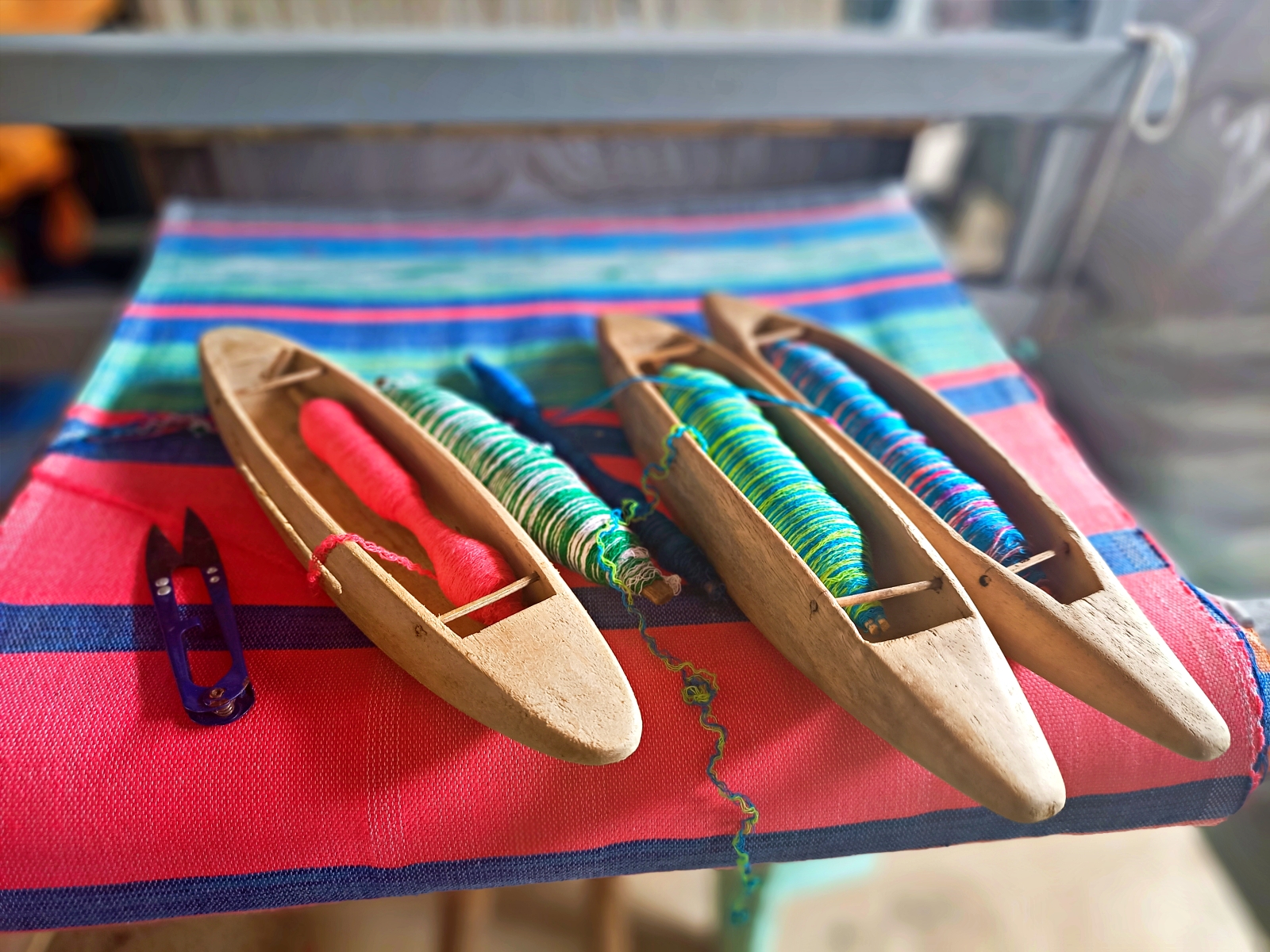
As told to us by Clarita Noble of BOKPA, the practice of handloom weaving quickly faded out when *ukay-ukay* garments from abroad and shopping malls displaced local clothing producers.
The four houses we visited were located not far from each other. Each has its own weaving pedal looms. One creates purely table runners and bedsheets, another specializes in bags and shoes, while the others make a variety of both.

I also discovered that the more than seventy members of BOKPA and the creators of Buhinon Woven Products were not all women, as we met a male weaver whose voice cracked with emotion as he told us about the economic benefits his family had gained from him learning to weave.
Brewing Art in BidiBidi Café
Bernadette De Los Santos—an artist, social entrepreneur, environmentalist, and farmer based in Camarines Sur—founded BidiBidi (based on Bernadette’s childhood nickname) in 2017 by teaching more than 150 women in her hometown of Baao the skill of hand embroidery.

Unbeknownst to most, Baao was formerly the hub of embroidery in the Bicol region. By taking charge of the renaissance of the craft, De Los Santos' BidiBidi brings the craft's resurgence full circle, producing a seamless transition from that intriguing period in Baao's history to the present.
"My target beneficiaries were rural women, mostly the wives of farmers. Being a farmer myself, I know that they need extra income to augment the family budget," said De Los Santos.

By sourcing most of her sustainable materials from Buhi, BidiBidi formed and developed a lasting collaboration with the women weavers whose creations De Los Santos aptly describes as “Buhimian”—a reference to the municipality of Buhi and a play on the word *bohemian*, typically used to denote unconventional artistry.

Located on the ground floor of De Los Santos’ ancestral house in Baao, BidiBidi Café not only brews coffee and tea but embroidered, woven, and crocheted works of art as well.

The showcased BidiBidi merchandise, featuring De Los Santos' signature hand-embroidered faces, hangs on the walls, and the eclectic mix of artworks, art installations, colorful yarns and textiles, and repurposed furniture gives the space an artistic vibe. It came as no surprise for our group to be willfully “budol-ed” into buying numerous items from large to medium-sized bags, laptop sleeves, and smaller items.

The future looks promising for the communities in this region of Camarines Sur to market their long-standing traditional weaving practice as a major One-Town, One-Product produce through Sustainable Community-Based Tourism, thanks in large part to the workshop conducted by TPB and the already flourishing collaboration between BidiBidi and the Buhimian weavers of Buhi.


