Betis Church’s Mind-blowing Ceiling Mural | Pampanga

August 25, 2022
Delve into the exquisite ceiling murals and woodwork of Saint James the Apostle Parish Church in Betis, Guagua, Pampanga. Discover the history of this National Cultural Treasure, its connection to painter Simón Flores, and its profound impact on local faith.
Philippines / Pampanga / Heritage Trails

Betis Church’s Mind-blowing Ceiling Mural | Pampanga

By Marky Ramone Go August 2022

Artworks have been a popular means of narrative since time immemorial, as exemplified by the art of Ancient Egypt. One such excellent illustration of storytelling through art can be found inside Pampanga's Saint James the Apostle Parish Church.

The grand structural facade of Saint James the Apostle Parish Church in Betis Pampanga
A sure inclusion in every Pampanga Visita Iglesia

Buried but not quite by Mt. Pinatubo’s eruption: Bacolor Church and its story of survival | Pampanga

August 21, 2022
Explore the half-buried San Guillermo Parish Church in Bacolor, Pampanga. Discover the tragic yet inspiring history of a 16th-century Baroque church swallowed by Mount Pinatubo's lahar and resurrected by its resilient community.
Pampanga / Churches / Architecture

Buried but not quite by Mt. Pinatubo’s eruption: Bacolor Church and its story of survival | Pampanga

By Marky Ramone Go August 2022

Years after its 1991 eruption, the wrath of Mount Pinatubo continued to be felt. Case in point is the San Guillermo Parish Church in Bacolor, Pampanga. On September 3, 1995, after days of torrential rains, a raging lahar flow from the slopes of the previously thought dormant volcano buried the town about half a dozen meters deep.

Visita Iglesia in Pampanga
Only half of the church remains unburied by the lahar flow

After the lahar flow solidified it raised the ground 20 feet up, nearly swallowing the parish church in half as more than 50,000 people from surrounding communities fled to safer ground.

Cynthia Diaz
Only a peek remains from the church's pre Pinatubo explosion windows

Despite occasional lahar flows occurring following severe rains, the town folks of Bacolor banded together to salvage what remained of their parish church.

Kara Basamayor
The central Retablo of San Guillermo Parish Church

Residents took turns excavating the original retablo and other century-old statues of saints from the solidified muck, and soon after, they poured new concrete on the church's elevated floor, thus constructing a new church out of the buried one.

A formidable foe of nature

A bastion of the faithful’s spirituality, San Guillermo Parish Church also served as an emblem of resiliency as evidenced by the many forces of nature it has faced since it was originally built by the Augustinians in 1576.

Kara Basamayor
The façade of Bacolor Church in present day's half-buried state

After countless pounding from typhoons and tremors, the church finally bowed down to a strong earthquake in 1897. It was soon quickly rebuilt complete with a central nave and well-illuminated cruciform with windows. Inside, churchgoers would be seen kneeling in front of the central retablo when attending mass and reciting their prayers. On given occasions, they listen to special announcements from the priest who stands on the pulpit, which is highly adorned with gold leaves.

Say Tioco
The hallway leading to the small museum

Designed in Baroque-style of architecture and in honor of the town's patron saint, San Guillermo Ermitaño, the church also came with its own monastery, that was momentarily transformed into a headquarters by Simón de Anda, the Spanish Basque Governor of the Philippines, when the British attempted an invasion of Manila in 1762.

Bury me not

In what could have been a bane that spelled the end of the church's existence, has instead given San Guillermo Parish Church a deeper meaning for its parishioners by embodying the inseparability of faith and perseverance.

Kara Basamayor
Paintings and photographs depicting the aftermath of Mount Pinatubo's eruption

As I enter the church through its arched doorway now only half as high as it once was, I immediately sensed an aura of mystery and solemnity. The ceiling of the church, which in most old churches towers greatly, appears nearly reachable here, as if the church itself were squeezing the visitors' preexisting spirituality closer and making the whispers of prayers less muffled.

Kara Basamayor
The door looks so tiny

On the right wing of the church where the old convent was located is now transformed into a museum displaying recuerdos from the church's history, religious icons as well as images of the town of Bacolor and the church taken after Mount Pinatubo erupted.

Heidi Manabat
San Guillermo Church

Outside, I saw a couple of ladies throwing coins on a well. Despite my skepticism on such things, I plucked a 5-peso coin from my pocket, made a wish, and flipped it up backward unto the well.

Ria De Borja
Wishing for tomorrow's peace of mind

I walked towards the outer walls of the church at the back where the extent of the lahar flow appear more obvious. The sight took my emotions all over the place as I think about the town residents' determination to restore the church from its ruinous state.

Considering everything that Bacolor Church has been through, it probably wasn't a coincidence that it was used as a setting for the 2010 ABS-CBN primetime series May Bukas Pa. Because, as the title suggests, there will always be another day to soldier on, just what the people of Bacolor and San Guillermo Parish Church have shown.

An edited version of this article first appeared on SpotPH.

The Ramon Magsaysay Museum & Ancestral House | Zambales

August 18, 2022
Step inside the ancestral home of President Ramon Magsaysay in Castillejos, Zambales. Reopened by the National Historical Commission of the Philippines, this multi-gallery museum offers an intimate look at the life, family, and timeless leadership legacy of "My Guy."
Zambales / History / Presidential House

The Ramon Magsaysay Museum & Ancestral House | Zambales

By Marky Ramone Go August 2022

There have been a few points in our history where it may be said that the Philippines can’t seem to catch a break. One such event occurred on March 17, 1957, when a plane carrying President Ramon Magsaysay crashed on Mount Manunggal in Cebu, ending a promising term in which Magsaysay became popular because of his accessibility to the common people. Magsaysay, who was known as "My Guy" because he was everyone's buddy, is widely regarded as the best head of state the Philippines has ever seen. However, as luck would have it, he passed away in office and in life far too soon, leaving behind a legacy of greatness we could only hope could be replicated by current and future leaders.

Front exterior view of the historic Ramon Magsaysay Museum structure in Castillejos
Mambo, mambo, Magsaysay. Remember that classic tune?

A Reminder of Greatness

What better way to ensure that Ramon Magsaysay's excellence is not forgotten than to have a museum built in his honor? Furthermore, having a central location that houses and highlights his services to this nation could enable more people to learn about him and his enormous impact other than history books, articles published about him, and documentaries.

The grand stone and timber gateway entrance of the ancestral home
This museum is worth stopping by going to and from the beaches of Zambales

Fittingly, the Magsaysay family's ancestral home in Castillejos, Zambales, where the young Ramon spent years that coincided with a period that largely influenced his character, was renovated by the National Historical Commission of the Philippines (NHCP) and reopened as a museum in December 2016.

An exact replication of President Magsaysay's office desk setup inside the museum
Felt good sitting behind a President's desk.

The two-story museum displays several of Ramon Magsaysay's personal belongings. The galleries on the first floor feature vintage photographs taken with other prominent personalities such as Emilio Aguinaldo, Carlos P. Garcia, and Richard Nixon. A stack of telegram messages between Magsaysay and other well-known people, such as Carlos P. Romulo, are stashed in a folder on another desk.

A guest testing the custom 360-degree virtual reality headset gear station
Take advantage of the museum's VR feature for a better experience

There's also a glass-encased exhibit of some of his favorite outfits, including his old Air Force uniform and a few barongs he wore as President. The .45 caliber handgun reported to have been used by Magsaysay during an encounter with Japanese soldiers in the Zambales hilltops stands out in the World War II area.

The historical recognition plaque identifying the heritage site details
The museum is one of NHCP's 27 recognized museums in the country

His numerous honors and recognitions received during his stellar career as a soldier and public servant are also displayed near his desk, placed beneath the Presidential Seal, including the Order of the White Elephant from Thailand, the Order of Saint George from Greece's Most Exalted Order of George, and a Guest of Honor Medallion from the Philippine Youth League's Leader of the Year Awards.

A curated display wall featuring archival monochrome photographs of key historical events
Some of the old photographs on display

All in all, the Magsaysay museum is divided into three main sections: Magsaysay's Life, Magsaysay's Family, and Magsaysay's Death and Legacy. Another feature of the museum is the Ramon Magsaysay 360-degree VR Experience written by Ed Geronia and produced by the NHCP. Using headsets provided by the museum, visitors can view various scenes depicting a number of important moments in Magsaysay's life including the moment when he uttered his iconic line "Malacañang is the palace of the people".

Glass-encased archival garments including traditional barongs and military apparel
The former President's barong tagalogs and Air Force uniform

I grew up in a house where both my parents were deeply involved in following the state of politics in our country. I used to recall seeing them in frustration while they tell me about the Martial Law days and would often mention, “If only we can have another Ramon Magsaysay as President”. It dawned on me then how Magsaysay’s brand of public service has since become this barometer of how a great President should be. Sadly, people like him only come around as often as Halley’s Comet nowadays.

Archival print display depicting the massive crowd gatherings during Magsaysay's state funeral processional routes
Thousands lined up the streets of Manila to mourn Magsaysay's untimely passing

We can only hope that this museum will further spread the legacy and example set by Ramon Magsaysay when it comes to truly serving the people so it may inspire legions of leaders cut in the same cloth as Ramon Magsaysay.


Klook.com

More than a Surfer’s Haven, Baler is where one can Travel, Breathe and Dive

August 09, 2022
Discover the holistic transformation of Baler, Aurora, from its iconic cinematic surfing roots to a premier wellness and deep-sea sanctuary. Follow travel journalist Marky Ramone Go through an immersive exploration of the DOT's 'Travel, Breathe and Dive' campaign featuring oceanfront sound healing, dynamic yoga paths, and raw freediving.
Philippines / Baler / Wellness & Adventure

More than a Surfer’s Haven, Baler is where one can Travel, Breathe and Dive

By Marky Ramone Go August 2022

Many decades after the painstaking filming of "Apocalypse Now" gave rise to the country's perhaps first surfing destination when the film crew left their surf boards behind, the name Baler has become associated with surfing. While Colonel Kilgore in the film referred to the Viet Congs as "Charlie(s) (who) don't surf," in real-life Baler, everybody surfs.

Sunny skies greeted us upon arrival in Baler's long beach

More than just a Surfing Paradise

However, as a surfing culture formed in the ensuing years, Baler increasingly became a destination of choice for individuals seeking a brief escape from the major metropolis. Surfers and other nature and adventure enthusiasts were subsequently joined by travelers who came with a variety of interests ranging from local cuisine, meditation, self-care, spirituality, and to some, a digital nomad stop. Soon after, the once exclusively surfing paradise was converted into a holistic utopia serving as melting pot of diverse curiosities.

Yoga and Freediving essentials from DOT Region 3 and Aurora Tourism Office

Tapping on this expanding allure of Baler to travelers, the Department of Tourism Region III organized a “Travel, Breathe and Dive” event to showcase a couple of activities that fit ideally in the town’s setting: Yoga and Freediving.

Yoga and Meditation Sessions

When I signed up as a media participant for the event, I was most excited about the freediving classes since I had always wanted to experience this underwater sport. The other components of the program, which included various yoga practices, were just secondary highlights for me.

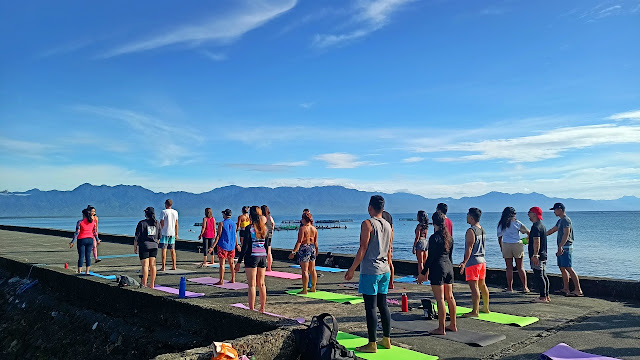
Our first Yoga spot for the day overlooking the Pacific Ocean
Our first Yoga spot for the day stretched across the lawn grounds of Baler Beach Club

Yet, after only a few minutes of our first meditation practice, the activity we're performing immediately aroused my attention. I immediately felt a connection to the environment around me as we laid on our yoga mats stretched out on the lawn grounds of Baler Beach Club, overlooking the Pacific Ocean and beneath a canopy of trees and the blue afternoon sky.

Sound Bathing session led by Kara Basamayor
Teacher Sound Bath as we call her, Kara sounds off her healing sound instruments she bought in Nepal

Under the guidance of our session teacher Kara Basamayor, we were asked to soak in sound waves created by various therapeutic sound instruments such as Tibetan singing bowls, chimes, gongs, percussion, spinning forks, and even Kara's soothing and harmonic voice.

Yoga stretches preparation for deep water freediving blocks
Yoga and Freediving actually goes hand in hand since practicing stretches all your body parts which helps avoid cramping underwater

I realized I was wrong to dismiss the wellness part of the program. I was completely dazzled by the entire experience that lasted more than an hour. We concluded the practice with a breathing exercise and a tea meditation attracting positive energies.

Baler's natural landscape providing zen backdrops for yogis
Baler's nature gifts allows Yogis to practice against gorgeous scenery for added Zen

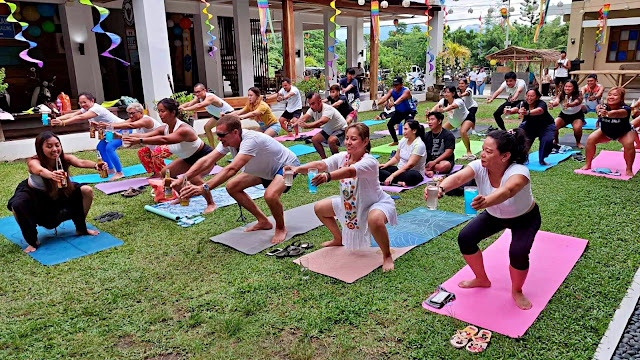
The next couple of days saw us attending different Yoga classes covering Vinyasa, Hatha and even Beer Yoga with Yoga teachers Lorelee Sicat and Camille Ramos.

My Introduction to Freediving

I've been wanting to try freediving for the longest time. Since meeting Valerie Bautista at an event campaigning against the spread of fake news in 2017, I've wanted to give it a go. Valerie, the founder of Azul Freediving, encouraged me to join a freediving lesson a few times but couldn't fit my schedule with her teaching sessions. Fortunately, Azul Freediving was part of the collaboration with DOT Region 3 to map out freediving spots in Baler.

The budding coastal freediving lines in Baler
100 meters ahead hides one of the budding freediving sites in Baler. We had our intro here

Together with her fellow instructors from different freediving schools from Batangas and Panglao, Bohol, the team identified a few promising dive sites — one of which served as location for us newbies’ introduction to freediving.

A freediving participant ascending to the surface lines
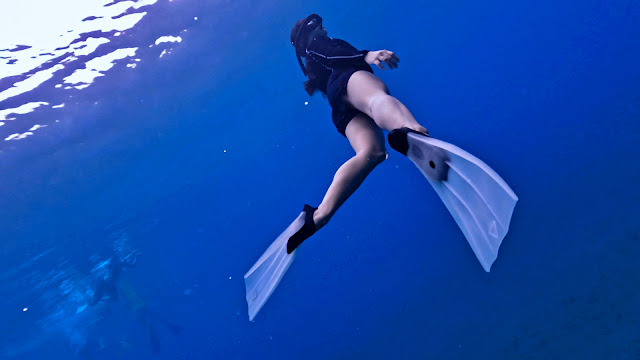
One of the freediving participants about to emerge from the water

The next day, we traveled to Dipaculao beach, where we began with an hour-long lesson on the fundamentals of freediving. It was followed by actual pool practice, where I clocked 1 minute and 48 seconds of breath hold on my second attempt. It was an excellent time for a beginner, according to my assigned instructor.

Freediving orientation lines with instructors in deep waters
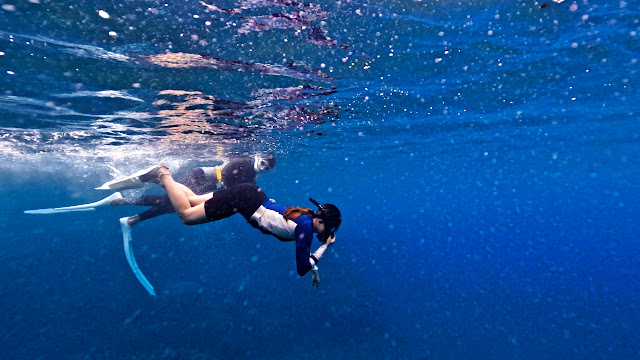
Us newbies felt safe under the watchful eyes of our freediving instructors

We proceeded to the dive location after the pool session to finally attempt the techniques of entering the water from above. From there, we are to apply a normal swimming motion underwater for as long as we could hold our breath. Despite failing to stay underwater for more than 30-seconds owing to my inability to properly kick myself under the water, I got a taste of what it's like to overcome my fear of the wide ocean.

Crediting this new experience, I now see myself making plans to go on freediving trips soon.

Seasoned freediver Pia Cortez gliding under the water column
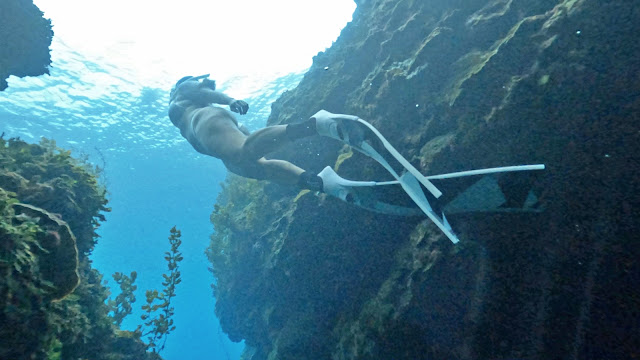
Seasoned Freediver and Influencer Pia Cortez weaves her way underwater

Travel, Breathe and Dive

More yoga sessions are sandwiched between our freediving activities. This includes one session of gentle flow at Baler Fish Port where we were surrounded by the gleaming glitter of the turquoise seas against the bright sunlight. The whole four days were filled with yoga, meditation, sound baths, food trips, coffee hunting, free diving, and, of course, a little surfing.

Gentle Flow yoga tracking blocks at the Baler Fish Port platform
Before we go to our next freediving spot, we had a Gentle Flow session at Baler Fish Port

Thanks to DOT Region 3 in collaboration with the Provincial Government of Aurora and LGU units Baler and Dipaculao, a new campaign is put to motion showcasing Aurora Province's untapped potential as an underwater and wellness attractions.

Beer Yoga session layout with structural backdrop in Baler
Our Gentle Flow yoga teacher Lorelee made our Baler experience more memorable with this fun Beer Yoga session

"The #TravelBreatheDive program of DOT Region III envisions the unique combination of dive and wellness to create a holistic, sustainable, and inclusive tourism product offering for Central Luzon," said Chriselle May Yambao, Supervising Tourism Officer at DOT Region III.

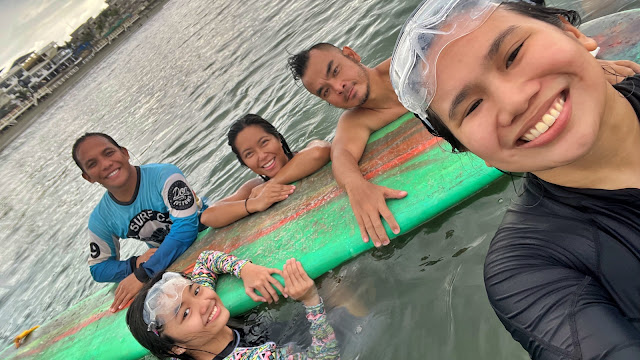
Catching standard surfing breaks along the Baler shoreline layout
Can't leave Baler without a bit of surfing

Yambao’s colleague Christian Ray Lingat also pointed out that the waves that helped Baler become a surfer’s haven are also responsible for the promise of other diving locations. "Strong waves generate underwater treasures including sea caves, tunnels, and fissures that serve as a marine refuge and a shelter for divers alike."

While the DOT Region 3 and the Baler LGU are currently ironing out the freediving locations in hopes of making them available to general visitors soon, the wellness tourism is now set to take off.

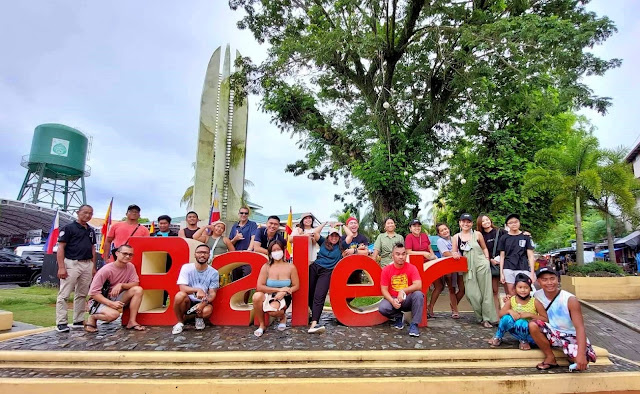
Full media delegation group photo for the Aurora campaign project
With fellow participants of Baler's "Travel, Breathe and Dive" event

Echoing the town’s new tourism campaign, one can easily travel wide, breathe good vibes and dive into a wonderful community in Baler.

This article also appeared in the print pages and online version of BusinessMirror.

Balay Hamoy Museum: Unearthing a New Footprint of Jose Rizal in Dapitan

August 06, 2022
Explore the historic Balay Hamoy Museum in Dapitan, Zamboanga del Norte. Discover the deeply personal pre-colonial and Spanish-era footprints of Dr. Jose Rizal during his exile, his friendship with Don Mariano Hamoy, and the meticulous restoration of this 1893 ancestral home.
Museums / Zamboanga del Norte / Mindanao

Balay Hamoy Museum: Unearthing a New Footprint of Jose Rizal in Dapitan

By Marky Ramone Go August 2022

The Spaniards had hoped that Jose Rizal's banishment to Dapitan, a sleepy town in Zamboanga del Norte that faces the Sulu Sea, would finally break his spirit, since it was so far removed from the cities where he had lived and thrived with fellow La Liga Filipina members. Our national hero, on the other hand, has other plans. Rather than accepting defeat, Rizal made his presence in Dapitan felt deeply by members of the local community.

Young locals in 1890s traditional attire at Balay Hamoy Museum
These young men and women channeling 1890s fashion

According to historian Ambeth Ocampo, Rizal made the most of his exile by doing a variety of things in Dapitan. He taught kids at a small school, founded a health clinic, created a relief map of Mindanao in front of the Baroque-styled St. James Church, assisted in the construction of a small dam, and, more significantly, he formed close bonds with many of the inhabitants, including forging a friendship with a certain Don Mariano Hamoy.


Balay Hamoy’s Connection to Rizal

The history of Balay Hamoy can be traced back to 1893, when Don Mariano Hamoy and his wife Doña Pilar Sagario first built the house. The Hamoy couple would occasionally entertain Dr. Jose Rizal, whom they had befriended during the latter's exile in Dapitan, at this house. Rizal even delivered baby Pablo, Don Mariano and Doña Pilar's firstborn child.

The staircase and historic entrance to the courtyard of Balay Hamoy
The staircase and entrance to the courtyard

While the house would remain in ownership of the Hamoy family's direct descendants leading up to its current owners Peter Hamoy and his wife Kat Uyehara, it would take more than a century before this house will be added to the footprints of Jose Rizal in Dapitan.

The dark brown wooden exterior architecture of Balay Hamoy
The dark brown wooden exterior adds a timeless charm to Balay Hamoy

From the moment the house was given to me by my parents Mariano Lastica Hamoy and Clariza Azcuna Adasa we immediately planned to restore Balay Hamoy but had to wait for the right time and enough funds to start the restoration.” Peter Hamoy said.

Vibrant heritage hallway inside the Balay Hamoy Museum structure
The vibrant hallway leads you to the two bedrooms

While the issue of restoration funds remains a big question mark, the right moment arrived when the Hamoy’s youngest daughter Hitomi approached her parents with a tearful eye and said: “Dad, Mom I researched on my great, great grandfather Don Mariano Hamoy and the article said he is the forgotten friend of Dr Jose Rizal! Why is he forgotten?”, Hitomi asked. “Something has to be done for people to remember him. His story and the story of his friendship with Dr. Jose Rizal must be shared”, she adds prodding her parents to finally take that leap of restoring the old Balay Hamoy.

The ancestral master bedroom setup at Balay Hamoy
The master bedroom as it looks like centuries ago — without the A/C of course

The Hamoy couple realized the moment they had been waiting for had arrived after being moved by their history-loving daughter's plea. Despite limited resources and a business that had suffered from the pandemic, Peter and Kat decided to restore the old Balay Hamoy, fueled only by a desire to tell their family's story and its connection to our history, as well as knowledge gained from years of research in house restoration.

The historical archival library inside Balay Hamoy Museum
The library boasts of a collection related to Philippine history

A Restored Past Now on Display

As the country began to emerge from the grip of pandemic restrictions, Balay Hamoy gradually underwent restoration until, by the time the city celebrated Jose Rizal's 130th anniversary of arrival in Dapitan, the door of Balay Hamoy is finally ready to welcome curious minds about the city’s storied connection to our national hero.

Diorama detailing Dr Jose Rizal and the Hamoy family interactions
A diorama of Rizal's interaction with the Hamoy family

Our main goal of the restoration and preservation was to tell a story of the rich history and heritage of Balay Hamoy and the Dapitanons who lived in those times,” shares Kat Hamoy. “We also want to share the untold stories of Dr. Jose Rizal and Don Mariano Balsomo Hamoy’s friendship and the legacies they left to Dapitan” she adds.

Ribbon cutting grand opening ceremony of Balay Hamoy Museum in Dapitan
Balay Hamoy Museum owners Peter and Kat Hamoy with Dapitan Mayor Seth Jalosjos, DOT Regional Director Krisma Rodriguez, CCP VP Chris Millado and National Museum Director Jorelle Legaspi during the ribbon cutting ceremony

Coinciding with the Kinabayo Festival and the Revisitamos Dapitan 1892, the commemoration of Rizal’s 130th year anniversary of arrival in Dapitan, Balay Hamoy Museum opened to the public to a simple celebration attended by historian Ambeth Ocampo, CCP VP Chris Millado, National Museum Deputy General Director Jorell Legaspi, National Artists for Music Ryan Cayabyab and Dance Alice Reyes, Dapitan City Mayor Seth Jalosjos and DOT Tourism Regional Director Krisma Rodriguez and a number of history and heritage advocates.

Diorama panel depicting Jose Rizal delivering infant Pablo Hamoy
Depiction of Jose Rizal delivering the baby Hamoy

"Rizal has left a footprint on the Dapitanons. He spent four of the most productive years of his life in Dapitan", Dapitan Mayor Seth Jalosjos said.

The preservation layout of the secondary guest bedroom inside Balay Hamoy
The other bedroom of Balay Hamoy

The Balay Hamoy Museum, which houses old materials relevant to Rizal's time in Dapitan as well as a diorama of the Hamoy's interactions with Jose Rizal among many other interesting items, is a welcome addition to the Jose Rizal trail in Dapitan.

Department of Tourism delegation panel documentation shot
Photo courtesy of DOT

Balay Hamoy Museum is located on Mi Retiro Street in Dapitan's heritage district, just a 3-minute walk from other Rizal footsteps landmarks such as St. James the Great Parish Church, Rizal's relief map of Mindanao, Rizal Monument, Casa Real Marker, and more.

Crowd Surfing in the Busy Chandni Chowk Market |Delhi, India

August 01, 2022
Explore Chandni Chowk, Old Delhi's 17th-century marketplace. Built by Shah Jahan, this "Silver Street" is a tangled web of humanity, vibrant spice markets like Khari Baoli, and historic architecture. Experience India in its purest, most authentic, and crowded form.
India / Delhi

Crowd Surfing: Navigating the Labyrinth of Chandni Chowk

By Marky Ramone Go August 2022

Stepping out of my accommodation, Zostel Hostel, into a 16°C Delhi morning, I was eager to witness some bustling street activity. Little did I know, "bustling" would be a major understatement for what I was about to experience. I should have braced myself, because my destination—Chandni Chowk Market—is not just one of the oldest but also the busiest market in a city known as one of the most crowded in the world.

Chandni Chowk Market Scene
Canals (now closed) once divvied up the market to reflect moonlight.

Chandni Chowk, located near the Old Delhi Railway Station and the Red Fort, whose massive walls stand at its eastern end, was built in the 17th century by Shah Jahan, the Mughal Emperor of India and the builder of the Taj Mahal.

Chandni Chowk Redevelopment
Taking inspiration from Heritage Street Amritsar, Chandni Chowk was redeveloped as a heritage trail.

Originally designed as a half-moon-shaped plaza with a man-made channel sourcing water from the Yamuna River by Shah Jahan's daughter Jahanara, Chandni Chowk already houses over 1,500 shops where traders have set up bazaars selling silver — thus earning the market a moniker of "Silver Street." Aside from the hundreds, if not thousands, of shops and restaurants, Chandni Chowk Market is surrounded by a slew of historic buildings. The most popular, the 1650-built Jama Masjid, is said to be one of India's largest mosques.

Indian Herbs and Spices
All the ingredients, herbs and spice you can think of are here

A Tangled Web of Humanity

Even though the heart of the market is at least 2 kilometers away from Zostel, a few hundred meters had me already counting small pockets of marketplaces. The crowd thickens as I walk further. I soldiered on, and after half an hour, I began to feel the pulse of Chandni Chowk as the yells of traders bargaining with shoppers grew louder.

Spice corners in Delhi
Wonder why Indian cuisine oozes with flavors and pops with color?

Walking through the labyrinth of this 17th-century Chandni Chowk market can overwhelm you at first. However, once the shock of the crowd and the noise wears off, you'll find yourself enjoying the variety of items for sale here. You can find everything from silver and antique trinkets, jewelry, hanging lights, festive textiles, to electronic gadgets, custom tailored suits, and up to 1,000 different kinds of sarees just to list a few.

Sari sellers in Chandni Chowk
Lady sellers adorned with colorful saris

That is, if you can easily get from point A to point B, which in Chandni Chowk looks like crossing an ocean — except it's a sea of human bodies gyrating in every direction, along with the occasional wandering cows, tuk-tuks, delivery trucks, and private automobiles whose drivers are crazy enough to pass through the market's busy thoroughfare.

Khari Baoli Spice Street
Khari Baoli is an entire street devoted to spices, dried fruits, and herbs.

My favorite part is the Khari Baoili Market, which has a vibrant fusion of colors from spices, nuts, tea leaves, dried plums, and mulberries, as well as emitting an aroma of everything combined. I resisted myself from buying some spices as I still have to spend several days in Pushkar after my Delhi side trip.

Delhi shopping scene
How much are these? "Very cheap only"

As I made my way back to the hostel, I remember the Spanish backpacker I met in Jaisalmer with my friend Aileen during my first trip to India in 2014. He was telling another European traveler and us about Mumbai. "You can't find a place to stand,” he said. "Everywhere you go is crowded,"

Sidewalk barber in India
I regret not having a haircut in one of this sidewalk "barbershop" in India

On that same trip, we went to Mumbai, and I found the city to be exactly what I expected it to be: teeming with people. While I truly think his description borders on exaggeration, I finally get the gist of the image he was describing as I slowly make my way through the market's sea of humanity. That morning at Chandni Chowk Market, I literally had to find enough space to wiggle my legs and gain some distance. This is India in its purest and most authentic form, I told myself.

More Travel Stories