Relishing the Sweet Sunshower in the Islands of Bulalacao | Oriental Mindoro
7 Reasons Why Danjugan Island is a Model of Nature Conservation
Where to Stay in Ortigas | Jinjiang Inn: More than a Business Hotel
Local Products Perfect as Christmas Gift This Holiday Season
Bandung, Indonesia | Tracking Nature Prints of Volcanoes and Heritage Trails
Things to do in Nakhon Phanom, Thailand
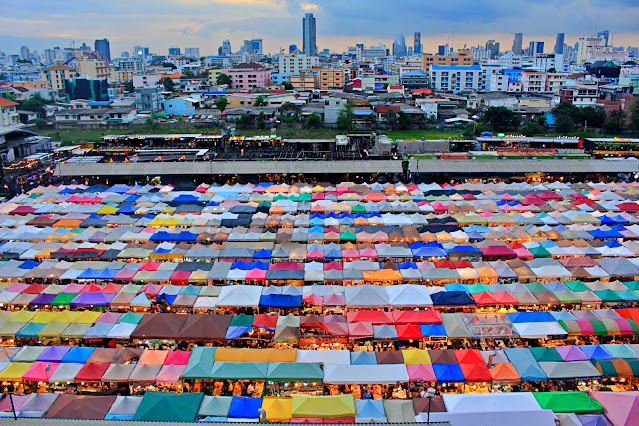
Shopping & Food Exploration at Ratchada Train Night Market | Bangkok, Thailand
Taking over the place of an abandoned railway station in the Chatuchack district of Bangkok, the Ratchada Train Market spreads out on an open-air field dotted with colorful tents selling the top of the pops of Thailand's street food culture, along with clothing items and an endless array of fascinating trinkets to fill up your suitcase — or if you're like me, your backpack.
Where to Stay in Dumaguete | the Flying Fish Hostel
2018 Mekong Tourism Forum | Sustainable Tourism, Exciting Start-Ups and Role of Influencers
Where to Stay in Manila | Hotel Benilde Maison De La Salle
#ForMindanao’s Peace Educators in Lanao Del Sur
Post-Marawi Siege Projects of #ForMindanao
Laos | Luang Prabang’s Laid-back Lure and Rich Heritage
Luang Prabang’s Laid-back Lure and Rich Heritage
I remember sitting inside a cramped van negotiating the snaking countryside road of Laos, feeling very excited as I reached my next destination. My high anticipation stems from the desire to unlock the truth behind the prevailing word-of-mouth on Luang Prabang. “The place is so laid-back,” fellow travelers would often rave. As simple as it may be, that description is music to my ears. Throw in the heritage structures and rich culture of the city, my giddiness got the best of me for the rest of my ride.
The allure of the historic district
Not to be disappointed, the moment the van dropped me off at the Historic Center of Luang Prabang, I instantly felt the old-world vibe. The imposing grandeur of the Royal Palace promptly satisfied my fondness for tasteful architecture. As the sky turns red and on the verge of giving way to darkness, the night market stalls began popping up one by one, gradually lighting up the streets. Soon, the crowd thickens but I didn’t mind, as I gleefully continue my exploration on foot.
Like a kid in a candy store, I stared with wide-eyed in wonder at the surrounding shops, restaurants and cafés—all housed inside the colonial-era establishments. Channel out the patrons busy fidgeting on their mobile phones, and you’d feel like you’re back in the prewar decades.
Monasteries, palaces, temples (or wats) and colonial houses abound in the pedestrian-friendly district of Luang Prabang. You could very well explore the whole place in a day, but who would want to sightsee in such haste? Definitely, not me. The charming vibe of Luang Prabang beckons, so I ended up staying for several days.
Witnessing the morning alms
On the first morning, I woke up early to witness the morning practice of the monks asking for alms. Also known as the “Tak Bat,” this daily ritual has become an important part of Luang Prabang’s culture. However, it has generated controversy in recent years, when tourists began participating and giving away nonedible items such as money. With respect to their culture, it is more appropriate to let the locals and devotees of Buddhism be the donor and for tourists to politely keep a safe distance from the monks.
Still, the experience of witnessing this ritual added a new layer to my spirituality, as I understand how the monks envisioned it to be—a practice in humility and detachment from earthly possessions. This humbling sight instills generosity and kindness that can never go wrong.
Wat-hopping on two wheels
The next couple of days, I did my exploration by riding a rented bicycle and went on a wat-hopping tour. Wat is the most religiously apt word to describe a Buddhist and Hindu temple in Laos, Thailand and Cambodia. The word wat was derived from the ancient Indian language of Sanskrit, which means “enclosure.”
With more than a dozen centuries-old temples built around Luang Prabang, you will never run out of ways to observe how Laotian people and the monks practice their faith. I started off at the Wat Xieng Thong, a 16th-century temple built by King Setthathirat.
Inside its walls, one can find intricate artworks depicting Laotian life, culture and religious practices. It is one of the most important landmarks in Laos because it was here where some of the earliest Laotian kings were crowned.
I spent the rest of the day pedaling to cover other temples until nighttime took me near the Royal Palace, where the adjacent Wat Mai monastery echoed the chants of the monks who were in prayers.
Food-tripping and quaint riverside cafés
During daytime, I would take a break from my cycling explorations by hanging out at the many quaint cafés all over town. Colorful shops, restaurants and coffee shops housed in colonial buildings added a new layer of appeal. I would sit down and order a Laotian latte and just stare at passersby. Nearing sunset, I would relocate to a riverside joint for an ice-cold Laotian beer while witnessing the sunset over the mighty Mekong River.
“Duterte, Duterte!” a waiter at a riverside diner playfully chanted after I answered his question, “Where you from?” “Yes, he is our President,” I responded and then I took a moment to stop myself from sharing my unsolicited political opinion.
The waiter proceeded to point out a standee of former US President Barack Obama drinking from a coconut. “That picture was taken here. Obama drank coconut here,” he proudly told me.
It as it were, I was just checking out the menu and wasn’t decided yet where to eat, but the Obama connection convinced me to book a seat. I ended up having an unforgettable early dinner with a stunning view of the golden dusk sky reigning over the quiet waters of the Mekong.
Standing on top of Mount Phousi
I capped my first visit to Luang Prabang by taking a short hike on top of Mount Phousi, a 100-meter high hill planted at the center of the historic district. As the clock ticks nearing my departure time, I spent a whole hour just staring at the lush surrounding countryside and trailing my sight to the adjoining water lines of the Mekong River and the Nam Khan River.
Looking at the charms of the old town from above, I thanked the heavens for bringing me to yet another destination teeming with history and colorful culture. As a flock of doves flew over me and into the sky, I saw them leave a track of shadows over the greens until they all disappeared into the blue. About the same time, I felt all my worldly worries vanishing and was quickly replaced by a sense of tranquility. I knew then, Luang Prabang had me lured and secured in its enthralling embrace.
Day Hike and Dip at Mt. Mamara and Tinipak River | Rizal
![]() |
| On top of the 1,200 feet plus Mt. Mamaru |
PAL’s Flight to Bangkok got even better with the Tri-Class Airbus A330
Thailand | Family-Friendly Destinations in Bangkok
Eye-Trick Pony at the 3D Art in Paradise | Bangkok
![]() |
| Inception, you say? |
Postcard Series: Ground Zero | Marawi
Postcard Series: Marantao | Lanao del Sur
Black Pencil Project Celebrates 10 Years of Sheer Volunteerism with TPB
On Travel Assignment | 2018 Madhya Pradesh Travel Mart
Sailing Soon in the Philippines: Things to do Aboard Royal Caribbean’s Ovation of the Seas
The Neolithic Rock Art Petroglyphs of Angono | Rizal
![]() |
| The Petroglyps of Angono was included in the 1996 World Monuments Watch |
Reveling Holi: the Festival of Colors in Jaisalmer | India
Reveling Holi: the Festival of Colors in Jaisalmer
I remember the sheen of the rising sun lighting up an ember at the edge of the hills of sand dunes. It is the first thing I saw from where I laid out on a mattress in the open desert. A few feet away from me, I noticed a black scorpion struggling to crawl away. I look up at our guide with a smile on his face. “Close call” he tells me before breaking into a grin. “They are poisonous but they don’t kill people” he adds. That prevented me from thinking the night we spent at the desert of Jaisalmer was a life-threatening one.
One by one; myself, Aileen and the five other Indian travelers we befriended rose up and marveled at the spectacular sunrise. As what we have witnessed the previous sunset, the rising sun over the desert of Jaisalmer is a picture to behold. It was a rarity finding myself unable to even capture it with my camera. I gazed at it like a lovelorn soul looking at a goddess.
Holee mubaarak
The youngest of our guide–already an expert camel herder–kick started the Holi celebration by yelling Holee Mubaarak (Hindi for Happy Holi) before our other two guides started tossing colored powders on us. Before we knew it, we were smudged with pink, yellow, violet, red and blue colors on our faces.
The Holi Festival is an ancient Hindu Festival known as the "festival of colors". Held predominantly in the Indian subcontinent, it celebrates the victory of good over evil. The manner it is reveled originated from the childhood pranks of Lord Krishna–the reincarnation of Lord Vishnu–of dousing village kids with colored waters.
Occurring every year on the day after the first full moon of March, Holi Festival coincided the morning after our magical experience of sleeping on the sand dunes of Jaisalmer.
Our trek back to the city of Jaisalmer was filled with gaiety episodes bookending with a bittersweet farewell to our camels–who proved to be loveable creatures of the unforgiving terrain of Rajasthan. I patted mine on the head and hear her make a sound as if acknowledging my gesture of goodbye.
More Colors in Jaisalmer
Although compared to other cities in India such as Vrindavan, Pushkar, Jaipur and Hampi, the Holi Festival in Jaisalmer appear more laid-back and intimate. There are no mosh-pit type of crowd gatherings on the streets. Rather, locals parade on the streets in waves of varying numbers from a handful to a couple of dozen.
Still, I can’t deny feeling the unique festive vibe of the Holi. After wiping the blotches of color powder on my face, I joined our group on the street of Jaisalmer with a clean slate. The locals seem to notice it because a minute later, we were all blemished again with rainbow colors. I love the fact that the revelers were polite about it. They always ask my permission before flinging powders to my direction. I was like “bring it on, I’m game for this”.
Around early noon, the euphoric vibe turned more chaotic as the crowd started to thicken. Chaotic in a way it should be–otherwise it won't be the Holi I've always wanted to witness.
Good Karma brought the Holi to me
I wouldn’t have known that in my excitement to book cheap plane tickets to Kolkata would overlap with the Holi Festival. I just picked two random dates 26 days apart in March to pencil my first ever visit to India.
Four years later and after a couple more return journeys to India, and the memory of that Holi Festival remains as crystal clear in my head. I can still hear the laughter of the jubilant merrymakers as we all chuck colored powder in the air, catching it by dancing under it facing the sky and with outstretched arms.
Living up to the original emphasis of the Holi rituals to shy away the demoness Holika, I felt like I've shed my own inner demons as well. My initial trip to India not only opened my eyes to a wider world, I also discovered my good karma–the main mechanism that brought me there. A favorable fate that shall come aplenty, if only we can continue doing things at the pure desire of our heart and soul.
A Dark Night inside Langun Gobingob Cave | Samar
Postcard Series: Travel Bloggers in Nong Khiaw | Laos
Beer the Blues Away: a non-alcoholic’s guide to befriending beer during tumultuous times
Witnessing the Ethnic Kaamulan Festival in Malaybalay, Bukidnon
Postcard Series: Waiting for Sunset in Nakhon Phanom | Thailand
Clarin House of Suman | Misamis Occidental
![]() |
| Suman always goes well with a hot cup of Sikwate - a Filipino chocolate made from tablea (ground cacao beans) |
India: A Journey Through Time and Color
From the Cordilleras to the Seas
Exploring the Heart of the Archipelago
Discover this Region's Cultural Depth
Beyond Borders: A Southeast Asian Odyssey