Showing posts with label cagayan. Show all posts

Cagayan Travel Guide: Nature Spots and Other Places of Interest

March 21, 2024
A comprehensive guide to Cagayan, Philippines. Explore the Blue Lagoon of Baggao, the historic Cape Engaño Lighthouse on Palaui Island, the volcanic wonders of Mt. Cagua, and the cultural chambers of Callao Cave. Discover the "Northern Frontier" from Tuguegarao to Sta. Ana.
Philippines / Cagayan Valley / Adventure

Cagayan Travel Guide: Nature Spots and Other Places of Interest

By Marky Ramone Go March 2024

Cagayan, situated on the northern tip of Luzon, typically gives visitors second thoughts due to the 12-hour or longer land journey from Manila. Doubt no more, wanderers; there are daily direct flights from Manila to Tuguegarao, the province's capital city, and the plethora of attractions — natural, cultural, and cultural landmarks — make a long-distance trip to Cagayan well worthwhile for those who choose to drive.

Cape Engano Lighthouse View
View from the Cape Engaño lighthouse

To further convince you of either hopping on a plane to Tuguegarao or taking that half-day road trip, here are some destinations in Cagayan you may want to visit in the near future and a few must-things to do.


Take a Dip at this Blue Lagoon in Baggao

The Blue Lagoon, as the locals baptized it to describe its azure-colored streaming waters, used to be the north's undiscovered gem, but that is no longer the case, much to the delight of travelers.

Blue Lagoon Baggao Cagayan
The waters of Blue Lagoon invites you to take a dip

The Blue Waterfalls, Cave, and Lagoon, located in the forested area of Baggao, Cagayan, is presently managed as a sustainable tourism destination by its local community. Hikers are led by resident guides trained by the Tourism Promotions Board of the Philippines (TPB) to a series of spectacular nature places, including waterfalls, caverns, and natural pools that lead to a blue lagoon straight out of the famous Brooke Shields film.


Set out on a Scenic Trek to Cape Engaño Lighthouse at Palaui Island

If a land trip to Tuguegarao takes at least 12 hours, try adding 2-3 more hours going to Sta. Ana, Cagayan, and another 45 minutes of boat ride to Palaui Island. What arduous traveling you might say but wait till you get a glimpse of what awaits you on top of the hill where the Spanish-era lighthouse Cape Engaño stands.

Cape Engano Lighthouse Palaui
A sure inclusion in every list of most beautiful lighthouse views

A breathtaking panorama of the island's lush vegetation, jagged cliffs battered by Pacific Ocean waves, and stunning turquoise ocean water. Let's just say that traveling to Palaui Island is well worth it because it will undoubtedly provide you with amazing core memories.


Chasing Waterfalls and Volcanic Crater at Mt. Cagua

Visit Gonzaga for a double dose of natural wonders. A 3-4-hour climb at a brisk pace will lead you to Mount Cagua's caldera, a really unique natural feature highlighted by a boiling crater lake releasing sulfuric fumes. Wear a face mask to prevent inhalation, but also open your eyes to this incredible spectacle.

Mt Cagua Crater Lake
A remarkable sight after a 3-4 hour hike

An hour-long hike from Mount Cagua's volcanic crater takes you over rugged boulders and into the towering Cagua Falls, where you may take a relaxing plunge.

Cagua Waterfalls Cagayan
Cagua Waterfalls


Explore the Chambers of Callao Cave

Callao Cave is easily accessible from Tuguegarao and by foot from the jump-off point, with an established track leading inside. A sequence of stalactite and stalagmite rock formations will astound you until you reach the main chamber, dubbed "the chapel," because it is a modest church built by the locals. Above the rock altar, a mystical ray of light emerges from the main chamber's aperture.


Witness the Circadian Flight of Bats in Pinacanauan River

Visitors to Callao Cave may enjoy a kayak journey along the serene waters of the Pinacanauan River, which is not far from the entrance to the cave.

Circadian Bat Flight Pinacanauan
Bats flying out of their cave.

Your scenic river cruise will become even more memorable when your guide takes you to an area beneath a massive wall with a large circling hole. Wait until a few moments after dark to see the circadian flight of bats, when tens of thousands of bats emerge from the hole and into the evening skies.


Experience Beltfishing in Sta. Ana

Part of the "Nature and Adventure" tourism circuit penciled by the Department of Tourism Region 2, this experiential activity involves visitors teaming up with a seasoned fisherman to set out more than 20 nautical miles off the coast of Brgy. Diora-Zinungan in Sta. Ana, Cagayan.

Beltfishing Sta Ana Cagayan
Kuya Wilfredo, a beltfisherman, shows us how its done

Your mission, should you wish to accept it, is to catch a load of beltfish, also known as "espada," utilizing the fishing boat's one-of-a-kind "kariti," a local version of a hydraulic pulley. This is where the angler ties three thin wires with bait before weighing down on the water to entice the beltfish to bite.


Enjoy a fun (and slippery) Hike to Buwacag Falls

The common warning “slippery when wet” can't be any truer when following the trail to this waterfalls. The slick path is just a reminder of how off-the-beaten path Buwacag Fall is. Buwacag's many cascades, nestled among verdant woodland on the Sierra Madre's slopes, provide an ideal environment for a nature retreat.

Buwacag Falls Cagayan
Yes mam, sir, I'm going to take a swim here

Just be careful stepping on those dodgy rocks, and we're sure you'll have a fantastic time in this emerging outdoor destination in Sta Ana, Cagayan.


Anguib Beach

Many people refer to it to as the "Boracay of the North". However, Anguib Beach should be known by its own name, not in comparison to other beaches. It distinguishes itself with its unique blend of elements.

Anguib Beach White Sand
Chillin by the beach

Nearby, there is a mangrove forest to explore, hills to walk, and a long stretch of pristine white sand beach to stroll on. Other destinations that can be combined with Anguib Beach are Crocodile Island and Mapurao Beach.


Meet the Potters of Iguig

In the town of Iguig, the One Town, One Product (OTOP) pottery creations take shape. Here, you can observe the men and women who have continued this backyard industry passed down from generations, create pottery items from slabs of clay.

Iguig Pottery OTOP
The perfect souvenir stop

Looking for a souvenir item? then the town of Iguig is the perfect pit stop for you to shop for some pottery items of various shapes and designs.


Take a Soulful Visita Iglesia

Complete a Visita Iglesia especially if you’re coming to Cagayan during Holy Week by visiting these churches located in the different towns of the province.

St Philomene Church Alcala
St. Philomene Church in Alcala

There's the St. Peter Metropolitan Cathedral in Tuguegarao, Basilica Minore de Nuestra Senora in Piat, San Antonio de Galicia Church in Iguig, St. Philomene Church in Alcala, San Jacinto de Polonia Church in Camalaniugan, and Sto. Domingo de Guzman Church in Nueva Segovia.

St Peter Metropolitan Cathedral Tuguegarao
The Saint Peter the Apostle Metropolitan Cathedral

On top of gentle hillsides overlooking the powerful Cagayan River in Iguig is home to the Cavalry Hills, a site with fourteen life-size sculptures of the Stations of the Cross.


Hit your Daily Steps Quota by Going on a Walking Tour of Tuguegarao

Rizal Park Monument Tuguegarao
Rizal Park Monument in Tuguegarao

In between hunts of the best pancit batil patong stalls, you can set out on a walking tour of Tuguegarao by visiting these places of interests: the 18th-century The Saint Peter the Apostle Metropolitan Cathedral, Cagayan Museum and Historical Research Center, the Buntun Bridge — one of the country's longest bridges, Rizal Park Monument, San Jacinto Church, and the 1907 founded St. Paul University just to name a few.


Oh, and Don’t Forget to Order Pancit Batil Patong

It’s an unwritten rule among tourists in Cagayan to never leave the province without trying the popular local specialty, Pancit Batil Patong. Better come hungry before ordering the Pancit Batil Patong because it is one heavy and satisfying dish. Its name was derived from the word "patil" which means "to whisk or beat" and "patong" referring to putting a topping on the dish such as a poached egg, sautéed vegetables, and minced beef.

Pancit Batil Patong Cagayan
Pancit Batil Patong

Famous Pancit Batil Patong places are Tabing Tulay Panciteria, Jomar's Special Pancit Batil Patong, Ed's Panciteria, Win-Mae Panciteria and the pancit stalls at the night market in Tuguegarao.


How to get to Tuguegarao, Cagayan

Both Cebu Pacific Air and Philippine Airlines have daily Manila - Tuguegarao flights. For commuting via land, bus companies such as Baliwag Transit, GV Florida Bus, Victory Liner and Delta Bus serves Manila, Cubao, Pasay, Kamias and Caloocan routes to Tuguegarao City.

This article first appeared on Spot.ph

For the Third Time, Palaui Island is Still a Charm | Sta. Ana, Cagayan

April 19, 2022


More than a decade has passed since I first journeyed to Palaui Island. Back in those days, I was still in my earliest phase of exploring the Philippines. Cagayan Province, being in the farthest northeastern part of Luzon, seemed like a foreign country to me then. Locating it at the map, I set out, myself and a couple of female friends, on a trip that would leave a beautiful set of remembrances in my memory vault. After a 15-hour bus ride to Sta. Ana, Cagayan followed by a 3-hour van ride, a half-hour boat ride and finally, a three-hour trek, we pitched our tent on a foot of a hill where the old Cape Engaño Lighthouse stands.


Marky Ramone Go

Cue in Silverchair's "The Greatest View"

Experiencing Belt Fishing in Sta. Ana | Cagayan

April 09, 2022
Discover the art of beltfishing (espada) in Sta. Ana, Cagayan. Join the fishermen of Brgy. Diora-Zinungan for a unique community-run experiential tour using traditional "Kariti" manual pulleys in the deep waters of the Philippine Sea.
Philippines / Cagayan / Adventure

Experiencing Belt Fishing in Sta. Ana | Cagayan

By Marky Ramone Go April 2022

Just as tiny rays of sunlight trail the sky and the fainter stars begin to fade in dawn light, we arrived at the coastal community of Brgy Diora-Zinungan in Sta. Ana, Cagayan. The method behind our madness of waking up early was to time our visit when beltfish, locally referred to as "espada" or "bulung unas", hunt for food in the deep waters of the Philippine Sea in schools.

Beltfish Espada Bait
An espada fish is also used as bait. You can make at least 8 baits from a beltfish this size

As we met with the fishermen, we were invited to gather for a brief orientation about what we are about to experience that day. Since beltfishing is the main source of livelihood for the residents, the Department of Tourism Region 2 included it in their newly-laid out "Nature and Adventure" tourism circuit.

Sta Ana Cagayan Fishermen Orientation
Running a bit late since the beltfish likes to swim with either under darkness or minimal sunlight

We learned from Kuya Wilfredo, the group's lead tour guide, that beltfishing began in Diora-Zinungan in the early 2000s when a fellow fisherman came home with 80 kilos of beltfish catch after venturing more than 20 nautical miles.

Attaching Espada Bait
Attaching the baits which are meat from an Espada fish.

In the years since then, they came to understand the beltfish's nature and instincts well enough to realize that they feed during long periods between dusk and dawn. They also pinpointed that beltfishes usually swim at an average depth of 80 fathoms, which is approximately 140 meters.

Kariti Manual Pulley Beltfishing
The Kariti, a manual pulley used to lower the baits to around 80-100 feet deep

Using the "Kariti" — a manual and cheaper version of the hydraulic pulleys used by the Taiwanese — the fishermen tie three thin cables with baits to each of the boat's three kariti and then set out on a 12-nautical mile area of fishing grounds. More fluent in Ilocano, Kuya Wilfredo manages to converse with us in Tagalog and narrated how they initially built a Kariti using the crank of a bicycle. "After numerous trials and re-designs, we finally came up with this Kariti design which we have been using for ten years now", he adds.

Setting out for the Catch

Split into threes, we boarded separate fishing boats, each manned by a pair of highly skilled fishermen, and set out for the ideal fishing grounds for "espada" fish, about 2-4 nautical miles off the coast of Diora-Zinungan. Fortunately for our group, one of our guides was Kuya Wilfredo who continued his lecture about the process of beltfishing as well as the personality traits of the “bulung unas”.

Lowering LPPCHEA Baits
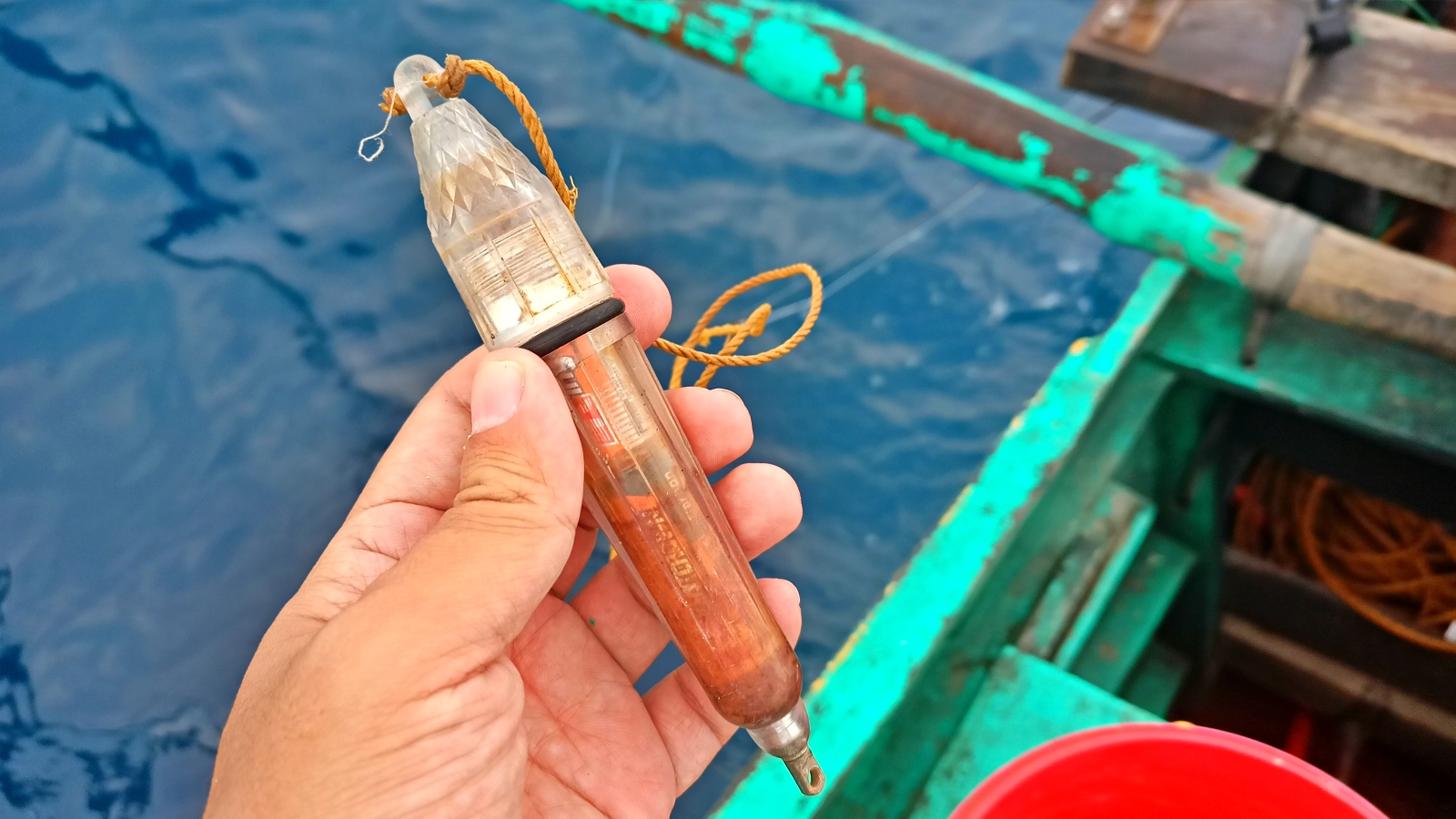
A blinking small lamp is also lowered with the baits

"The beltfish is different from other fish species because it will only pull the bait downward when hooked. This enables us to use three baits in one kariti because the cables won't get entangled if we simultaneously capture three of them" Kuya Wilfredo explained to us in Tagalog.

Fishing for Espada
Each Kariti can hold three cables with baits. Making it possible to catch three "espadas" in one drop

When we arrived on the area fishing ground, we started hearing cheers from the other boats as they started catching several beltfishes. One boat even caught a total of 12 beltfishes. Since our boat was the last to arrive after escorting another boat that experienced engine problems, we couldn’t catch a single one since the sun was already up.

A Community-run Experiential Nature Tour

Beltfishing has sustained the community of Diora-Zinungan for decades but concerns about its sustainability remains. "Before, any fishermen could easily catch 60-80 kilos a day", Kuya Wilfredo told us in Tagalog. "You'll be the one to give up and call it a day. Nowadays, it's a miracle to get 30 kilos every day", he continues.

Beltfishing Catch Cagayan
Mam Jane Salabit of DOT holds one of their catch

In light of the fact that fresh catch is diminishing in coastal areas that depend on fishing, having another source of income provides an attractive alternative for local fishermen. In this case, a community-run tourism business provides a viable substitute.

Catch from experiential tour
Not bad for an hour and a half's fishing experience. A catch from one of the boats

By offering an experiential beltfishing tour, the fishermen won't have to catch 30 kilos of fish to earn a living. They can guide tourists to catch a few beltfishes and viola, they can earn easily match or even surpass their regular income.

DOT Kulinarya Program Prep
One of the community mothers, starts preparing our espada fish lunch

A second advantage of this program is that it will give the beltfish population time to grow as fishing volume will be reduced by a significant amount. The Department of Tourism Region II plan to market this experiential tour combined with a beachfront lunch consisting of their beltfish catch.

Espada Fish Lunch Cagayan
Fried, Grilled and Sinigang na Espada.

For each tour's total catch, a third can be allocated to be prepared and cooked by the community mothers who are part of DOT's "Kulinarya" program, while the other two thirds can be bought from the fishermen and distributed among the community.

Group Lunch Sta Ana
Group Lunch with DOT, DOT Region II, Cagayan Tourism and other Tour Operators

This set-up is a win-win scenario for everyone. First, beltfishes will be able to repopulate, second, tourists will get to experience something unique and lastly, the fishermen will earn from their tour-guiding job while the community also benefits from other tourism-related services.

Sta Ana Cagayan Jump-off Point
The jump-off to the beltfishing experience is still undeveloped but there are plans to build a small visitor's receiving and orientation area and a place to have lunch in the near future

As this program is still in its infancy stages, visitors wishing to experience beltfishing should contact the Department of Tourism Region II to be connected with a tour operator who will coordinate with the community.

If These Waves Rocking our Boat Could Chill for a While | Anguib Beach, Cagayan

April 08, 2021


Prayers often trumps all. Indeed, ours was answered after a day of failed incursion to Callao Cave due to heavy rains. A glimpse of the blue skies appeared. This means our sea voyage to Anguib beach and Palaui Island is greenlighted and thumbs upped by the Coast Guard. Yet, what they say about "Be careful what you wish for", since unbeknownst to us that time, the weather still has a trick up its sleeve to surprise us.


Klara Iska Anonuevo, Kara Santos
Still unaware of what's waiting for us

Calayan Island | A Sweet Hereafter Return

July 02, 2019
Discover the raw, untouched beauty of Calayan Island in the Babuyan Channel. Join travel writer Marky Ramone Go on a historic return voyage via its maiden flight, exploring the majestic cliffs of Cibang Cove, the windswept vistas of Nagudungan Hill, hidden sea caves, and pristine waterfalls.
Cagayan / Calayan Island / Eco-Adventure

Calayan Island | A Sweet Hereafter Return

By Marky Ramone Go July 2019

Not missing the blustery 7-hour lampitaw ride of my first journey here, I stepped out of the plane—moments after it made a historic first landing on the island—buoyed by a feeling akin to rekindling a tryst with a former lover. Calayan Island has that effect on me. It could be because last time, the place served as a background to my memorable hilltop and beachside frolics with my then girlfriend.

The stunning panoramic stretch of Cibang Cove in Calayan Island
The long stretch of Cibang Cove in Calayan Island

While this second time was for a writing assignment witnessing a historic first: the maiden flight to Calayan Island, I cannot dismiss the fact that a sense of fondness is being revived. Being summoned to once again explore the island’s stunning landscape is like being given a second chance to create a new set of memories in a place that always reminds me of splendid memory reels from four years ago.

Postcard-Image Cibang Cove

After a brief ceremony inaugurating the small airport of Calayan Island, we hit the explore button immediately and boarded a speedboat. Sailing over cerulean-colored waters had me jolting back into a spell of enthrallment. For the second time, I found myself embracing the island’s grand scheme of charms.

Aboard a speed boat sailing the pristine blue waters of Calayan Island
Photo courtesy of Sir Noel Amata

It didn’t take long before I gazed at the direction of a drawn-out cove known as Cibang. The same place where four years ago I was almost swept away to the sea by its mighty waves. Beyond that near brush with drowning, it was also the same place I defined to myself as the most beautiful length of oceanfront I’ve ever seen in my entire life.

The azure colored waters of Cibang Cove in Calayan Island

Knowing full well that memories have a way of exaggerating, I stared at Cibang Cove’s white sandy shoreline as it sparkles like jewelry against the gleam of the sun. Mesmerizing still. I directed my gaze at the forest that fills the surrounding serrated peaks before turning my attention to the lunar-like rock formations jutting out into the volatile ocean. “Yep, this is the Cibang Cove I remember”. Raw, desolate, and tempestuously absorbing.

Media participants frolicking along the fine white sandy shores of Cibang Cove
Frolicking in the fine sandy beach of Cibang Cove in Calayan Island

As our speedboat capers to the motions of the heavy rollicking of the waves, we each struggled transferring to a small buoyant device that took us to the shore. Finally out of the boat and with my feet planted on the soft, fine sands of Cibang Cove, I took off my shoes and walked barefooted.

Tourism Promotions Board staff wading through shallow coastal waters on a local raft
Because our boat can't come close to the shore, we have to ride this. Photo courtesy of Sir Noel Amata

Sinking my feet and feeling the scorching sands at every step, I tuned in to the sounds of the battering waves as they collide with the coastline. The blending of the colors all around me: white sands below me, indigo waters behind me, emerald forest-covered crests on my other side, and the blue skies above me, all constitutes a sense that I was inside a postcard image. The lure of taking a dip in the crystal-clear waters was strong. But my craving for big lobsters and curacha crabs was mightier. So I headed straight to the other end of Cibang Cove and into a waiting feast.

Fascination Redux at Calayan

After our late lunch shared boodle-fight style, we rested a bit before proceeding to Nagudungan Hill. The short and breezy hike atop this rolling mound overlooking sequences of beguiling scenery of deep ravines, the Philippine Sea and the Pacific Ocean on both sides, and Cibang Cove below, brings back the same captivation Calayan left on me during my first trip here.

A sumptuous beach boodle fight spread featuring massive island lobsters and curacha crabs
Lobsters and curacha crabs are a common food on the island

This time around, as I separated myself from our group, I lumbered to the different high points of Nagudungan and immersed myself in the exceptional set of bounteous, beautiful nature around me.

The author leaping for joy against the windswept horizon of Nagudungan Hill
That's me jumping for joy at the beautiful scenery atop Nagudungan Hill

While listening to myself think, I saw one of the ladies from the Tourism Promotions Board of the Philippines wandering on her own nearby. I first noticed her during our plane ride to Calayan Island and figured her to be a snob. Here on top of Nagudungan Hill, though, she was all jovial and doing all gamely poses. “Sir Marky, it’s so beautiful here,” as Genesis initiates small talk. Not long after, we were indulged in a conversation centering on the beauty of the island and how rejuvenating it is to leave all worldly worries behind.

Breathtaking visual lines of Cibang Cove seen from the high points of Nagudungan Hill
View of Cibang Cove from Nagudungan Hill

Later, as the sun started to set, we joined the others seated over a patch of grass sharing a bottle of a locally made wild berry wine. Together, we watched the sunset slowly sink into the horizon.

TPB representative Genesis Lee relaxing on an outdoor hammock setup on the grassy hills
Genesis is game 24/7 for some editorial type photos. Photo courtesy of Sir Noel Amata

As the sky became an image of a scattered Roman candle explosion, I laid on the grass for a few minutes more. Delighted at experiencing the untouched splendor of the island once again, I turned the pages of my first Calayan Island experience into a new chapter: Fascination Redux. And “this is only day one,” I told myself.

The deep golden sunset burning brightly over the dramatic horizon lines of Calayan

Unending Quests

The next day, I awoke to a morning sky equal parts blue and a medley of streaks of red and blooming yellows. The rising sun was partly hidden by the clouds, and the waves of the sea kissed the pebble-filled beach with abandon. I took a short walk along the beachfront, eager to continue our exploration of the island. A couple of dogs snooped at the sands as they followed me. The icy daybreak wind then hushed me to sit on a rock and just stare at the endless swirling of the ocean’s whitecaps.

Lone beach walk during early dawn light over the rocky shoreline parameters

After breakfast, we divided ourselves into three groups, boarded a smaller boat, and cruised over the seas in a maritime convoy. Our first stop was Lusok Cave ('Lusok' is an Ilocano word for 'hole'), where a natural pool is hidden behind twin passageways beneath a mammoth, craggy-rock wall.

Inside, we took turns diving into the refreshing indigo waters—a mixture of the sea and the fresh water dripping from the walls of the cave. Afterwards, we headed back to the island and visited the waterfalls of Bataraw and Caanawan—but not before enjoying another boodle fight feast consisting of fresh seafood and lechon by the roadside near Bataraw falls.

The media team gathered around a rustic outdoor banquet spread surrounded by island greenery

Caanawan falls is located a few kilometers upland and necessitates riding a powerful habal-habal (motorcycle) to get to the jump-off point. From there, another 10-minute hike takes you to the waterfalls.

The multi tiered freshwater columns of Caanawan Falls nestled deep inside the forests

It was almost nighttime when we got back to Apollo Resort in Dadao Beach—where we’re billeted. Weary from back-to-back days of exploration and still high from the euphoric inauguration of Calayan Island Airport, we spent the night further bonding together. All wholeheartedly supportive of the TPB and the Calayan LGU’s plan to maintain the rawness of the island—despite the new developments, we all feel the excitement at the prospering of sustainable and responsible tourism practices on the island in the coming months.

My return trip to Calayan Island was more than the "second time is a charm" cliché; it is also an eye-opener to the importance of preserving the island against wrong forms of development. As Mayor Al Llopis told us, "We won't let investors use Calayan Island as their playground," I am assured that the island is in good hands for now.

The complete travel media delegation posing with local coordinates on Calayan Island
Photo courtesy of Sir Noel Amata

Special thanks to Wakay Tours for arranging all our tours, accommodations, and transportation on Calayan Island. If you have any questions regarding where to stay or what to do on Calayan Island, feel free to send them your inquiries.

Lakbay Norte 6: Shaping a Heritage in the Pottery Town of Iguig | Cagayan

April 10, 2017

Hundreds of years after what is believed to be the earliest industry that thrived in this part of Cagayan province, the town of Iguig is picking up where its ancestral settlers left off. By continuously shaping a heritage through the delicate hands of its artisan townsfolk; the soft natural rock material called clay – finds a home and purpose here.

A local artist demonstrates his expertise in pottery making. Photo courtesy of Martin San Diego / North Philippines Visitors Bureau (NPVB)

Northern Mission to Calayan Island

August 05, 2015

Huddled at the roof of our ‘lampitaw’ with other passengers, I sensed my leg muscles cramping a little bit. We’re not yet at the first hour of our six-hour sea journey to Calayan Island and I’m already uneasy with my chosen seating position, numbing my butt over a protruding piece of wood. A few minutes later, we started encountering the unstable waters of the South China Sea. For a moment I dread my recollection of tales of waves as big as a two-story house from happening, but as I stare out to the sea, I notice the steady condition stretched out as far as my eyes can see. Feigning the worse, I regaled at the sight of the Volkswagen-sized breakers battering our lampitaw. “These waves can’t possibly topple our durable boat” I told myself with a swagger and a brief recitation of prayer. 

Monette Santillan surveys the scenery in Calayan Island

On The (Long) Road to Palaui Island | Cagayan

December 05, 2010

Our long Bonifacio weekend trip to Palaui Island was far from easy. It's difficult for my buttocks, which became numb 5 hours into our bus ride from Cubao to Tuguegarao, and that's only the first half of the 10-hour journey. We left the Victory Liner terminal in Cubao around 10 p.m. and arrived in Tuguegarao around 9 a.m., with brief stops in Tumauini and San Pablo, Isabela to visit two Spanish colonial churches.

Alyanna Bromeo

We spent the day in Tuguegarao, visiting Callao Cave and taking a leisurely boat ride along the scenic Pinacanauan River to witness the circadian flights of over a million bats –a sight which left me in awe. The next day we woke up early to prepare for another 3 hour trip to Sta. Ana, Cagayan by buying some things needed for camping out at Palaui Island. We passed by the Metropolitan Cathedral of Tuguegarao and rode the Sta. Ana bound van by 9:30 am.

Alyanna Bromeo

The sun was shining brightly, and I was wide awake for the majority of the journey. We passed through charming little towns that I'd love to visit if we had more time. Out the window, I see endless rice fields dotted with ducks, cows, and carabaos. I also paid attention to the kilometer markings on the side of the road because the final kilometer marker of "642 KM" is located in Sta. Ana.

Lauren Denoga and Sharlyn Del Rosario

I enjoy the sensation of long rides when my butt becomes numb and my mind races to something, such as plotting a bloodless revolution, and what better way to do so than by passing through God's painted creation? Another thing I noticed were the bridges; I lost count of how many we passed through, probably because the Cagayan River is a complex river system that branches out in all directions, including the aforementioned  Pinacanauan river.

Alyanna Bromeo

I also saw Port Irene, a place where car enthusiasts can buy imported automobiles at a much lower price; however, given Cagayan's political ties, I can only speculate on the legality of those imported cars. We arrived in Sta around 1:00 p.m. Vicente Port is located in Sta Ana, Cagayan. Following a brief rest, we rented a boat for 800 pesos two way (good for 6-8 people), a reasonable fee given our group of six.

Mujee Gonzales and Gretchen Filart

Palaui Island is home to approximately 500 people, the majority of whom are fishermen's families. A Navy detachment is also stationed on the island, where we registered our names. There are always fishing boats coming and going from Palaui to Sta Vicente port, so you won't be stranded on the island.


We were accompanied by two guides wearing shirts that said "Turismo Solusyon sa Kahirapan". Accordingly, it is the slogan of a tourism program that allow visitors on the island help local residents earn extra money. I don't consider paying for a guide as a "tourist trap" unless the location is easily accessible. These trained guides also help bring awareness on how to become a responsible traveler. We must all remember the importance of being responsible by refraining from bastardizing or vandalizing the places we visit. What I saw inside Callao Cave, where people etched their names on the rock formation, disgusted me.


Along with Benoit and Franco, our guides together with Franco's dog "Lambert", we took a hike that would take us another two hours to reach the other side of the island which is more ideal for camping. 


During the summer, the boat can take you directly there, but because we went at the end of the monsoon season and the beginning of the cold season in December, the waves aren't ideal for small boats to navigate, so we were only dropped on the part of Palaui facing Sta. Cagayan, Ana.


The hike requires a brisk pace but is not too strenuous because the terrain is almost straight throughout with little elevation change, but we took our time navigating the muddy section of the trail because your feet can get sucked by the mud up to a foot below your knee.

Lauren Denoga and Sharlyn Del Rosario

We arrived at the beach where we were camping for the night around 4 p.m., giving us plenty of time to set up camp, cook our late lunch and dinner, and go for a quick swim. We purchased crabs from Ate Simone, a local whose family makes a living by fishing around Palaui island.

Eileen Campos

Lauren prepared bacon and sausage, and Belle and her two other friends contributed hotdogs and corned beef. I also got to use the first tent I bought for myself for the first time. Yeah, having a "home on my back - wherever and whenever" is quite an accomplishment for me.

Eileen Campos

We drank alcohol and waited for stars to appear to illuminate the pitch black darkness around us. It briefly rained before the stars appeared. We attempted to sleep around 10 p.m., catching a few snatches of sleep before deciding to start the new day around 3 a.m., when we began cooking our breakfast.

Palaui Island

After sunrise we went atop the hill where the Cape Engano Lighthouse is located. Its a hike upward of about more than a hundred steps that affords you a magnificent view of the blue waters and other islets around the island breaking the waves while a strong wind tries to erase your face and attempts to blow you off your feet.

Palaui Travel Guide

It takes a long journey to Palaui Island when doing it by land; you could cut travel time by flying from Manila to Tuguegarao, but who would want to do that? We all wanted to take the expanded route so we took the bus from Manila to Tuguegarao for 10 hours, then another 3 hours to Sta Ana before hiking for another 2 hours for a total of 15 hours.

Alyanna Bromeo

Not bad spending the Bonifacio long weekend with a pilgrimage up north that also gave us an additional day when we passed by Ilocos on the way home to Manila by having a stop-over in Vigan.


I'm glad I was able to fulfill a year-long dream of visiting Palaui; I've been fascinated and intrigued with the place since seeing it on TV one boring Sunday, and what a great way to fill another supposedly boring weekend by living it up, packing my bags, camping gears and all, and dragging a few friends for the long, arduous but very memorable trip to this northernmost part of Luzon.


Shout out to my new friends, Carrie aka Lauren (her real name), who used to model for well-known photographers before quitting because "it has become a bastardized practice," she tells me, and Sharlyn, who wakes up late but goes to the bathroom half-asleep and of course, to the  Deuter brand, who gave me a 50% discount on my backpack "Deuter Futura Vario 50+10," a sturdy backpack ideal for long weekend camping trips.


More Travel Stories