
Witnessing the Week-long Bodong Festival Revelry in Kalinga
I have this image I play in my mind over and over when I think of Kalinga: Apo Whang-Od applying a batok (hand-tapped) traditional tattoo on my arm while I marvel at the presence of a Dangal ng Haraya awardee. That is how I envisioned my first visit to the province of Kalinga would be.

As things turned out, life, alternative travel plans, and writing assignments happened. My desire to set out to the mountainous village of Buscalan was shelved. Up until February of that year, Kalinga remained one of the three or four provinces in the Philippines I had yet to set foot in.

That changed during the week of the celebration of the Bodong Festival held in Tabuk City.
2023 Bodong Festival
The word “bodong,” which signifies a “peace pact,” is an indigenous judicial system that dates back to the historic past of the feared headhunting raids prevalent in the province. It was during this time when town elders exerted effort to forge a bodong between warring parties in order to end conflict inside and between villages.

Thankfully, in modern Kalinga, the practice of headhunting has been dead for many decades already. The violent culture of settling scores between opposing individuals, communities, and tribes has been eradicated completely.

In 2017, a festival was named for those who championed the custom of Bodong in their villages, following the province's rebranding of the Ulalim Festival, which had been celebrated since 1995.

Canceled during the pandemic, that year’s fourth edition of the Bodong Festival was also held simultaneously with the twenty-eighth Founding Anniversary of the province after it separated from the former Kalinga-Apayao province in 1995.
Street Dance Competition
The street dancing competition is an essential part of each Philippine festival. As one of the highlights of the festivity, the street dancing competition held near the rotunda along Manuel S. Agyao Boulevard in Tabuk gave the audience reason to erupt in wild cheers as contingents from different schools performed dance choreographies and stunts depicting local culture and traditional practices.
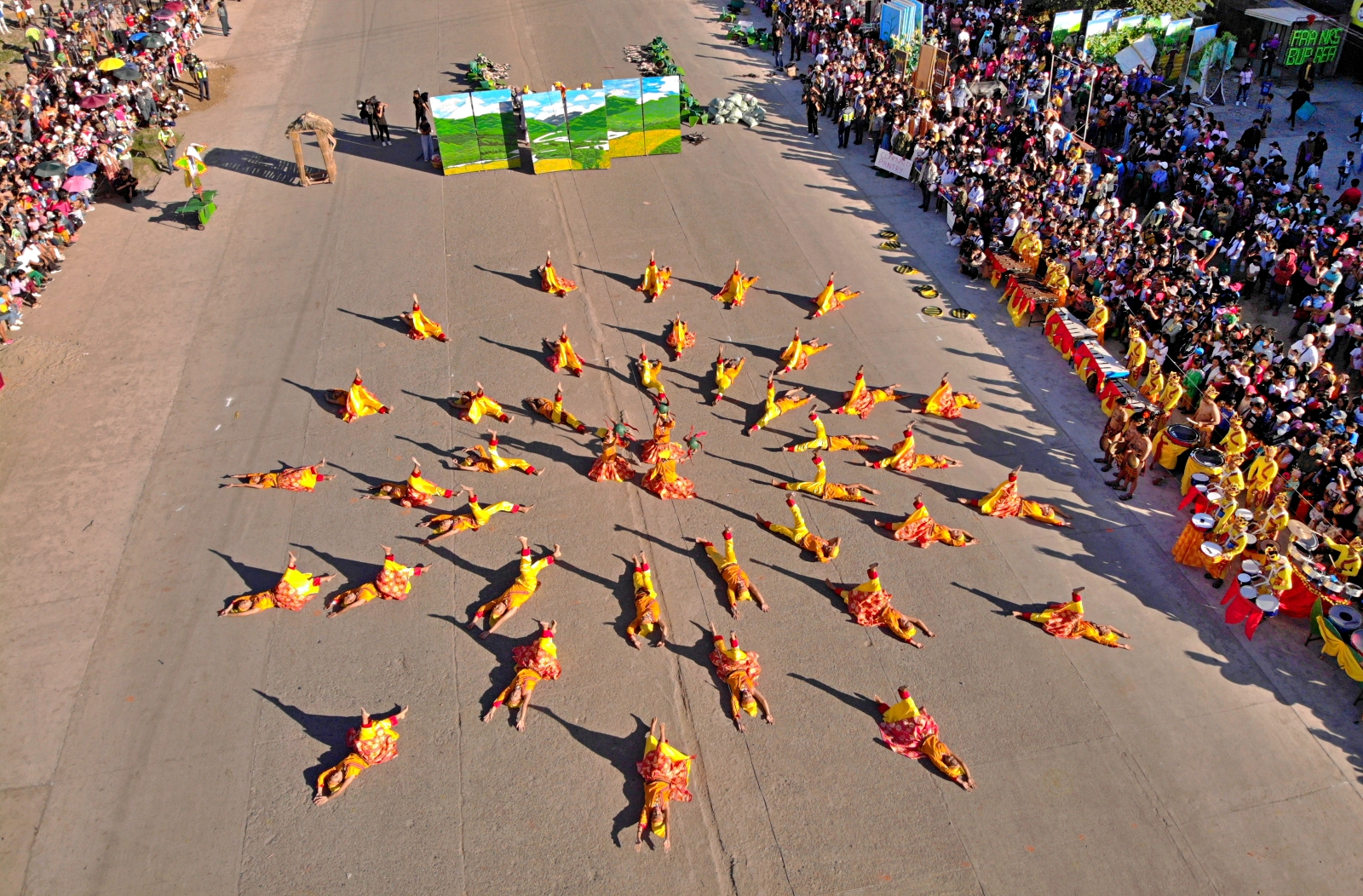
A common dance movement involves the “banga” dance. Women perform a waltz to the loud drumming beats by balancing up to six stacks of pots over their heads. This dance was inspired by women in isolated mountain areas who would fetch water from springs, store it in pots, and carry it back to their towns on their heads.

In all the festivals I’ve attended in the country, I find this traditional dance unique only to Kalinga. After more than a couple of hours, the dust settled, and the young performers from Kalinga National High School bested nine other groups to win the Street Dance competition.
The call of a Thousand Gongs, the Dance of a Thousand Pots
In other festivals in the Philippines, the street dance competition would be the crowning highlight. Not in Kalinga though, as brewing for some time was the desire to set a Guinness World Record for the greatest number of performers playing the gong instrument and performing the banga dance.

The Awong Chi Gangsa, Agtu'n Chi Banga (The Call of a Thousand Gongs, the Dance of a Thousand Pots) drew a whopping 3,440 male gong dancers and 4,681 female banga dancers. The musicians and dancers, who performed at the Kalinga Sports Complex, met strict performance criteria established by the Guinness World Records, including clean execution and synchrony.

Following the spectacular gong ensemble, which extended past midnight, Guinness official adjudicator Kazuyoshi Kirimura made the record official to the jubilant cheers of the performers and spectators.

The Awong Chi Gangsa, which signifies a call to prosperity and peace, was first performed in 2014 as part of the Ulalim Festival. Since then, hundreds to thousands of performers have participated, making 2018 the first year the province attempted to set the record.
Naneng Heritage Village
While I know that most visitors come to Buscalan for the obvious reason of seeing Apo Whang-Od and getting a traditional tattoo, I had been unaware of another interesting area to visit.

That is until we spent our first night in a homestay at this charming village called Naneng. One of the oldest villages in Kalinga, Naneng is where one can still witness traditional back-strap weaving being practiced, the 1927 Saint Joseph Parish Church, and several pre-WWII houses.

Pre-pandemic, this village was a favorite among foreign guests, mostly Israelis, who would stay in homestays here in between river rafting on the mighty Chico River and hiking to other places.

The 18-degree evenings, welcoming locals, and the village's fascinating culture made me want to stick around for a longer period next time.
A Glimpse of Apo Whang Od
While my first visit to Kalinga didn’t result in a meeting with Apo Whang-Od just as I envisioned it, I was blessed to have caught a glimpse of her. While I was busy helping myself to the buffet during a luncheon at the Provincial Capital, I happened to get a glimpse of the National Living Treasure nominee (Gawad Manlilikha ng Bayan) as she strolled by a few meters away. It turns out that Apo Whang-Od was not feeling well, so her companions were bringing her back to their hotel. Otherwise, I would definitely be sporting her signature dotted tattoo on my forearm by now.
It wasn’t meant to be, but count seeing Apo Whang-Od up close for a longer time among the many reasons I have for coming back to the province of Kalinga. For now, I better start planning my return trip.
*This article first appeared in the Tourism and Culture section of BusinessMirror.


