
The recent maiden Philippine Airlines flights to Tawi-Tawi from Cotabato City paved the way for me to explore the country’s southernmost province once again. I remembered when I first went here, I had met a slew of curious queries about safety when traveling to Tawi-Tawi. As many remembered, this province once hogged the headlines for all the wrong reasons.
Revisiting Tawi Tawi's Wonderful Sights and Culture
Tawi-Tawi at a Glance
Most visitors were perplexed by the Tawi-Tawi province. When people heard about it, they experienced a tug-of-war of perception. On the other end were yesteryear’s reports of brazen kidnappings and insurgency battles with terror groups. On the one hand, there were the rich cultural and natural wonders that were made more appealing by the generally friendly nature of the locals.

Fortunately, in the last couple of decades, the region flourished in peaceful times, and the former perception of Tawi-Tawi as a hotspot of insurgency was then far in its rearview mirror. Traveling to Tawi-Tawi at that time was no different from journeying to other places in the country.
A Taste of Local Cuisine
For five days, I explored the province once again, sampling local cuisine heavily influenced by the gastronomic culture of neighboring Indonesia and Malaysia.

Traditional grub like the martabak, a pan-fried flatbread stuffed with savory fillings, and other Mindanaoan specialties like satti—which was made of chicken or beef skewers swimming in a plate of sweet and spicy red sauce served with sticky rice balls—and a slew of Tawi-Tawi breakfast delights including wadjit, tsikalang, apam, putri mandi, pangi-pangi, palikambing, junay, and more, satisfied our cravings in between exploring several places.

But, of course, the one thing I was looking forward to was returning to Panampangan Island.

Second Time’s a Charm in Panampangan Island
Like a Groundhog Day-like echo of my first journey to Panampangan Island, I noticed our speedboat skimming through the serene waters of the Celebes Sea, while everyone remained hushed. I enjoyed the eerie silence as we glided through a body of water that was previously regarded as the most dangerous backwater in the world. The waters surrounding Panampangan Island—which were once a vicious playground of pirate ships conducting maritime robbery and, in the worst cases of many years ago, the travel path of Abu Sayyaf militants preying on civilians to kidnap—were then a picture of tranquil nature.

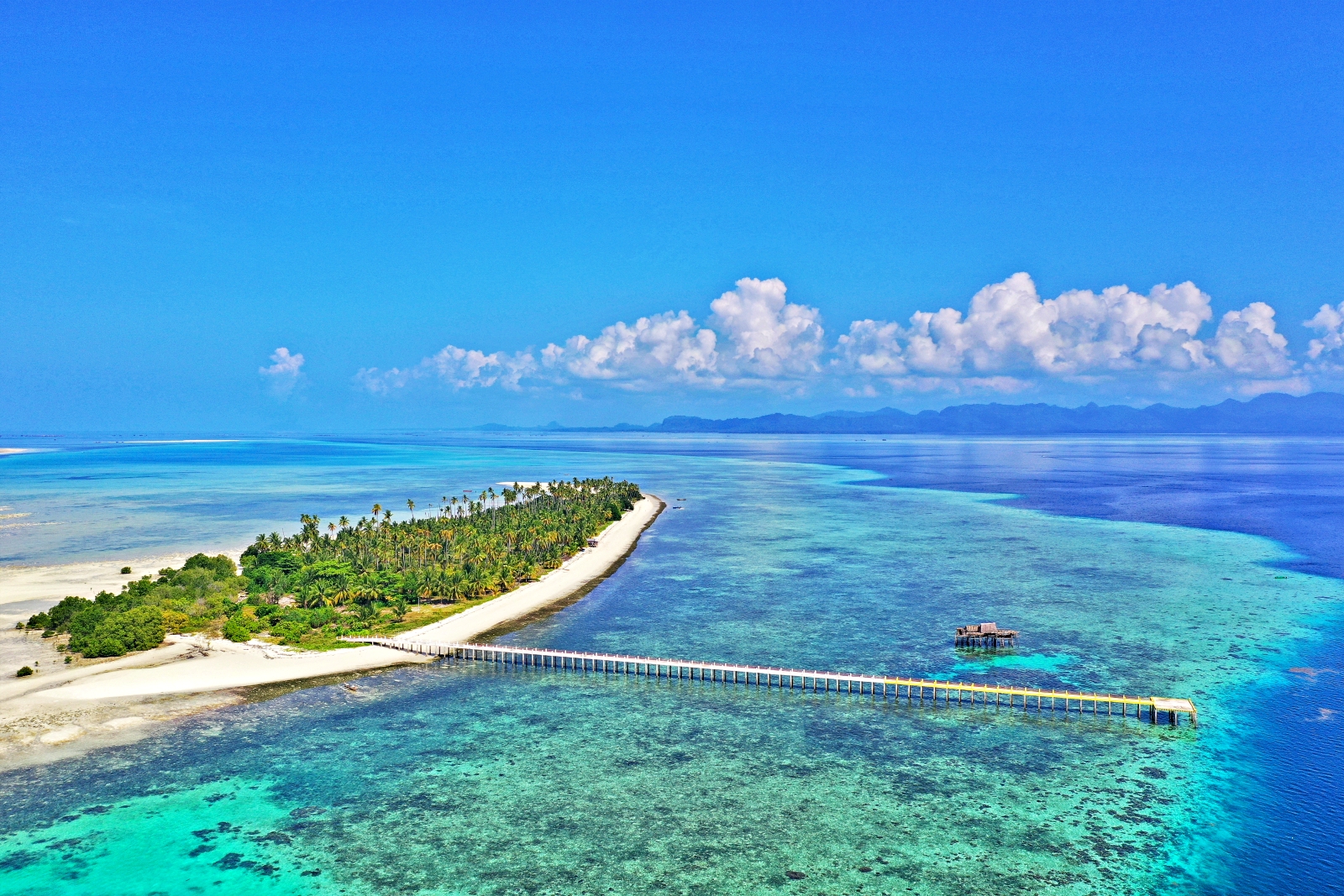
Panampangan Island was believed to have the longest sandbar in the Philippines. The sandbar, which extended to its neighboring islet, Basibuli, was said to measure roughly three kilometers during low tide.

Its end-to-end tip was separated by more than a thousand steps. I must have accumulated a few hundred, which was sufficient for me to thoroughly engross myself in the fascinating natural surroundings we were in that day. Nothing prevented me from listening to the waves' humming as I felt the hot sand of Panampangan Island beneath my bare feet, shining sun or not.

The island had almost no permanent structures other than a few small cottage sheds and a long wooden jetty, while the rest of the island was populated by coconut trees and random shrubs. Rows of Badjao stilt houses erected in the shallow part of the Celebes Sea could be seen half a kilometer away. During my first visit here in 2017, I remembered crossing paths with one of the Badjaos as I walked toward where the sandbar's edge disappeared into the deep. He nodded to me while speaking something in Tausug. I could only return his smile.
Sacred and Historical Sites in Tawi-Tawi
We also took the opportunity to visit other historical and sacred sites in Tawi-Tawi. One of these was the Sheik Karimul Makhdum Mosque. This mosque, located on the island of Simunul, was the Philippines' oldest mosque. It was named after its builder, Arab merchant and Islamic preacher Sheik Karimul Makhdum, who had come here in the 1380s. Despite the fact that the mosque had been rebuilt several times, four of its original wooden pillars were still preserved inside.

Next was Tawi-Tawi's sacred mountain of Bud Bongao. Standing only 1,100 feet above sea level, it held greater significance in the province's history, culture, and religion. Some even believed that one of the first followers of Sheik Karimul Makhdum, the Arab preacher who introduced Islam to the country more than six hundred years ago, was buried here.

Bud Bongao was still revered by the locals at that time. It was also a two-hundred-fifty-hectare biodiversity area protected by both the Bongao local government and the hundreds of playful long-tailed macaques who hung out along the trail to the top.

For a taste of the hustle and bustle of the local scene, there was the Old Chinese Port where a colorful row of lantsas (motorized wooden boats) immediately caught my attention. Hundreds of years ago, it was the main trading port for Arab, Malay, and Chinese merchants. At that time, it remained a major fishing and trading port, as well as an important seaport for the many islands of Tawi-Tawi, and in some cases, a gateway to Malaysia and Indonesia.

We also witnessed a trading system that I had thought had long since gone extinct—barter trade. In the municipality of Panglima Sugala, a town known as Tawi-Tawi's "food basket," there existed a marketplace where traders from the islands would exchange fresh seafood catches with agricultural products harvested by traders from the mainland—all without the need to pay in local currency.

Tawi-Tawi, the Philippines' southernmost province, remained a mystery to most visitors despite its colorful culture and fascinating history. It would have been a shame to overlook it in favor of other destinations.

Visitors to this province were rewarded with a memorable experience thanks to its diversity and colorful culture that had been preserved for hundreds of years. Previously overlooked and incorrectly associated with security concerns, Tawi-Tawi was quickly becoming a favorite option for travelers looking for a place brimming with cultural wonders and unforgettable sights.
🗓️ Suggested Three-Day Tawi-Tawi Itinerary
Execute a morning trek up the steps of Bud Bongao protected sanctuary / Explore historical anchors at the Old Chinese Port / Sip native Tausug Kahawa Sug coffee at downtown roadside stalls
Board a morning speedboat across the Celebes Sea lines to Panampangan Island / Walk the three-kilometer sandbar footprint to Basibuli islet / Profile distant Badjao stilt house communities
Cross paths to Simunul Island to document the original pillars inside Sheik Karimul Makhdum Mosque / Visit the ancestral barter marketplace lines of Panglima Sugala / Sample authentic chicken Satti spreads
The Tawi-Tawi Bucket List
What to Eat in Tawi-Tawi
Frequently Asked Questions
Yes. While the southernmost frontier was previously associated with historical security issues, the province has flourished in peace for over two decades. Today, exploring Bongao or Panampangan is as safe and welcoming as any premier island destination in the Philippines.
The powdery white coral sandbar connects Panampangan to the neighboring islet of Basibuli, extending to a record-breaking length of roughly three kilometers during low tide, making it the longest sandbar in the country.
While standard hubs like downtown Bongao and Bud Bongao are easily accessible on foot, organizing island-hopping speedboats to Simunul or Panampangan Island through the provincial tourism office or local operators is highly recommended for security tracking and smooth transits.
The municipality of Panglima Sugala proudly hosts traditional barter trading systems, where down-island fishing communities directly exchange fresh marine catch for mainland agricultural crops without standard currency notes changing hands.
Tawi-Tawi Frontier Blueprint
Nomadic Experiences Take
Tawi-Tawi deeply moved me because it wasn't just a rugged maritime gateway or a clinical frontier border post. It was a rare, pristine haven where centuries-old cultural dynamics and breathtaking raw nature coexisted naturally. One hour one was inspecting original 1380s wooden pillars inside our nation's foundational mosque, the next they were walking across a three-kilometer ribbon of powdery sand cutting through the clear emerald waves of the Celebes Sea. Few destinations in the Philippines manage to preserve that profound, golden-hued sense of pure historical discovery as flawlessly as Tawi-Tawi.


